Dividend Portfolio Update #11 – March 2025
PART I – Prologue Of My Journey
When I first decided to venture into dividend investing, I had no idea how much it would shape the way I think about stocks. There was something inherently comforting in the concept that companies would pay me just for holding their shares. It reminded me of planting fruit trees in a backyard—requiring an initial outlay of time and resources, sure, but eventually bearing fruit that you could enjoy season after season.
My journey started small, almost timidly, with just a few fractional shares of well-known companies. It wasn’t a grand plan at first, simply an experimental approach to see whether I’d enjoy the process. But as time went on and I watched the first small dividends roll in—pennies, really—I began to see how powerful reinvesting them could be. Each time a dividend arrived, the brokerage automatically purchased a little more stock, which in turn qualified for a slightly larger dividend next time around, and so on. This was the “snowball effect” that so many investing veterans extol, and I was seeing it in action, albeit in miniature.
Over time, my confidence grew along with the portfolio. I decided to add a bit more of my monthly income into it, spreading funds across different sectors. I looked for companies that not only had a track record of paying dividends but also a history of raising them. My thinking was straightforward: if these companies raised their dividends consistently, then over the years, my yield on cost would climb, and I wouldn’t even need the share price to go up in order to benefit—though of course, price appreciation would be a welcome bonus.
I also discovered the appeal of certain “dividend aristocrats” and “dividend kings”—terms for companies that have raised their dividends for 25 or 50 years straight, respectively. Yet I also wanted some younger, more dynamic companies in the mix. Enter big technology names that were either new to dividends or had the potential to pay them in the future. It was a bit of a hybrid approach: stable dividend payers like Microsoft and Apple on one side, high-growth or emerging dividend payers like Alphabet (Google) or Meta on the other.
The portfolio soon began to take shape as a series of fractional shares. While some might prefer owning whole shares, I found the ability to purchase fractional shares incredibly liberating. Companies like Costco, with a share price in the hundreds (or in some cases over $900 based on how it’s reported for fractional shares), were suddenly within reach. I could add, say, $20 at a time to keep nibbling away, building positions slowly but consistently.
One of my favorite moments came when I realized I had diversified into a surprisingly robust set of sectors without even trying too hard. I had financials in the form of a small, regional bank (Home Federal Bank of Louisiana, or HFBL), whose higher yield complemented my more growth-oriented tech holdings. I had consumer retail covered by Costco. I’d brought in Starbucks for a dose of consumer discretionary flair—and also because I genuinely love their product. Then there was Waste Management, which might sound unglamorous but is as vital a service as any. The more I looked at the mix, the more I felt comfortable that I wasn’t putting all my eggs in one basket.
Of course, no portfolio is perfect, and volatility can be nerve-wracking. There were months where the market would wobble—perhaps interest rates were rising, or inflation was spooking investors—and I’d watch the total value dip below my cost basis. Still, it helped that I had my eyes on the dividends. Even if the share price sank for a while, as long as the company’s fundamentals stayed healthy and the dividends kept rolling in, I felt anchored in my decisions.
Over time, I picked up the habit of reviewing the portfolio monthly. This gave me a structured way to reflect on how each holding had performed, how my dividend payouts had changed, and whether I wanted to initiate any new positions or add to existing ones. The process also taught me a lot about ex-dividend dates, record dates, and payment dates. Learning exactly when one must own shares to qualify for the next dividend was a straightforward but essential lesson in building a dividend-focused strategy.
During one of these monthly reviews, I found out Costco sometimes issues “special dividends”—one-off, extra-large dividends that can significantly boost a shareholder’s income for that period. That discovery reminded me that while consistent quarterly payouts are the bread and butter of dividend investing, surprises can happen, too. These occasional windfalls can sweeten the deal, especially for long-term holders.
Meanwhile, among my tech giants, Microsoft stood out for its cloud-based successes (like Azure) and strong history of raising dividends. Apple’s buybacks and consistent iPhone revenue streams kept it a sturdy anchor, though some might argue its yield is relatively low. Visa and Mastercard served as quiet cornerstones for payment processing—a secular growth space as more and more transactions move away from physical cash.
Meta and Alphabet remained the real wildcards for dividends. The portfolio tracker sometimes shows a small “predicted” payout from them, but the reality is that both have prioritized share buybacks over significant dividend distributions. If they ever decide to shift that strategy, the dividend portion could get exciting. Meanwhile, my small stake in each is partly about potential capital appreciation, which can still go hand in hand with the occasional small dividend.
In the midst of all these intricacies, the portfolio continued inching forward. I’d often reinvest my small payouts—like $0.08 from Visa or $0.02 from Starbucks—back into the very stocks that paid them. At first glance, those reinvested amounts might seem trivial, but it’s the principle that counts. Each fraction of a share purchased is a fraction that will earn its own dividend in the future. Multiply that by years of consistent investing, and you can see why so many swear by the dividend-growth approach.
Now, finding my portfolio above the $1,000 mark, and even nearing or crossing $1,100, feels both gratifying and like a mere stepping stone. I’ve seen how this works, how the “snowball” builds. Month after month, quarter after quarter, the consistent approach yields more comfortable returns—especially once the compounding effect kicks in more visibly. I also learned the importance of tracking everything on a dividend calendar.
By keeping an eye on ex-dates, I can know precisely which dividends I’ll soon receive and whether I need to purchase shares before certain dates to qualify. It adds an organized rhythm to the process, which is particularly helpful if you have many holdings. Throughout this journey, I’ve remained mindful of certain macro factors—interest rates, inflation, consumer sentiment, technology sector volatility—without letting them dominate my actions. Dividend investing, at its core, hinges on the belief that strong companies will continue to share profits with shareholders, even through economic cycles. By focusing on companies with proven track records and robust cash flow, I try to mitigate some of the risk and stay committed to a buy-and-hold strategy. In short, my story is one of patient growth, small incremental wins, and a fair share of daily fluctuation. But the real joy comes from seeing those dividend notifications roll in, no matter how small, and knowing that each one is a building block toward a bigger future. That’s why I encourage anyone curious to explore dividend investing. Start small, stay consistent, and let time and compounding do the rest.
PART II – In-Depth Dividend Portfolio Update #11 (Previously Provided)
Below is the in-depth version of the March 2025 update, which consolidates the holdings, recent dividend activities, and a strategic overview:
Dividend Portfolio Update #11 – March 2025
Apologies for the slight delay—let’s jump into our eleventh monthly update for this dividend-centric portfolio!
Overview
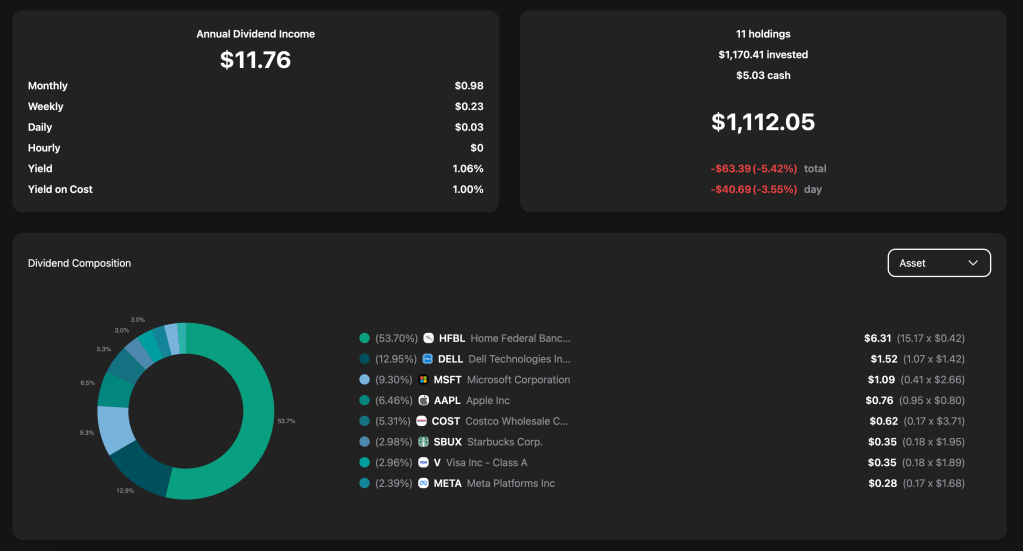
• Total Portfolio Value: $1,103.91–$1,112.05 (it fluctuates slightly depending on the snapshot)
• Invested: $1,170.41
• Cash on Hand: $5.03
• Number of Holdings: 11 stocks
• Key Milestones This Month:
• Breaking the $1K Mark (Again): Hovering above $1,100, the portfolio has made more upward progress since crossing four figures.
• Steady Dividend Payouts: Recent payments from Visa and Starbucks were reinvested. Pending dividends from Alphabet and Microsoft are on the way.
Portfolio Breakdown & Commentary
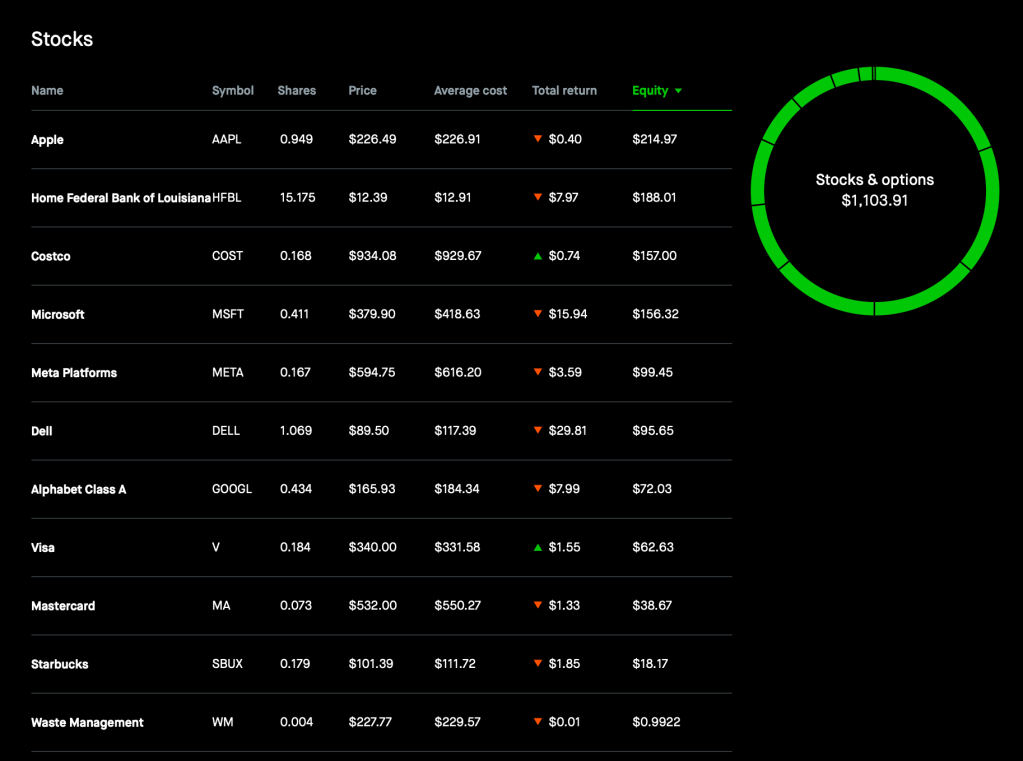
1. Apple (AAPL)

• Shares Held: ~0.949 @ $226.91 average cost

• Equity Value: $214.97

• Total Return: $0.40 (practically breakeven so far)

• Comment: Apple is my anchor tech dividend stock. Their dividend might appear modest, but Apple reliably increases it each year. Coupled with stock buybacks, it’s a solid long-term hold.
2. Home Federal Bank of Louisiana (#HFBL)

• Shares Held: 15.175 @ $12.91 average cost

• Equity Value: $188.01

• Total Return: $7.97

• Comment: This regional bank provides a higher yield than most of my tech names. Its stable, smaller-scale community banking model helps diversify my portfolio away from big tech.
• Comment: This regional bank provides a higher yield than most of my tech names. Its stable, smaller-scale community banking model helps diversify my portfolio away from big tech.
3. Costco Wholesale (COST)
• Shares Held: 0.168 @ $929.67 average cost
• Equity Value: $157.00
• Total Return: $0.74
• Comment: Costco remains a steady defensive play. Membership renewal rates are consistently strong, and Costco is known to surprise investors with special dividends now and then.
4. Microsoft (MSFT)
• Shares Held: 0.411 @ $418.63 average cost
• Equity Value: $156.32
• Total Return: -$15.94
• Comment: Despite being in the red on share price, Microsoft continues to deliver on its quarterly dividends. I have twopending MSFT dividend payouts: one in this Individual account ($0.31) and a small fraction in my Roth IRA ($0.01). The fundamentals remain strong (Azure, enterprise services), and I expect dividend raises to continue annually.
5. Meta Platforms (META)
• Shares Held: 0.167 @ $616.20 average cost
• Equity Value: $99.45
• Total Return: -$3.59
• Comment: Meta’s official dividend is still negligible, but some portfolio apps estimate a small payout. The real story is whether Meta can leverage AI and the metaverse to eventually establish a meaningful dividend policy. For now, I’m mostly betting on growth.
6. Dell Technologies (DELL)
• Shares Held: 1.069 @ $117.39 average cost
• Equity Value: $95.65
• Total Return: -$29.81
• Comment: This position has pulled back, but Dell’s dividend is a relatively new development post-spinoff. If they keep focusing on enterprise solutions and maintain a healthy cash flow, there’s room for the dividend to rise over time.
7. Alphabet (GOOGL)
• Shares Held: 0.434 @ $184.34 average cost
• Equity Value: $72.03
• Total Return: $7.99
• Comment: Google’s official dividend track record is basically at the starting line. I have a small pending dividend ($0.09) slated for March 17—though the real amounts remain small. Over the long run, if Alphabet decides to follow other big tech names in shareholder returns, that payout could climb significantly.
8. Visa (V)
• Shares Held: 0.184 @ $331.58 average cost
• Equity Value: $62.63
• Total Return: $1.55
• Comment: Visa is a lower-yield but high-growth dividend stock. I recently received $0.08 from Visa on March 3, and it was reinvested automatically. These small reinvested amounts slowly build up more shares—and each new share fraction qualifies for future dividends.
9. Mastercard (MA)
• Shares Held: 0.073 @ $550.27 average cost
• Equity Value: $38.67
• Total Return: $1.33
• Comment: Similar story to Visa—tiny yield, but consistent double-digit dividend growth rates. Over the long haul, these incremental payouts add up.
10. Starbucks (SBUX)
• Shares Held: 0.179 @ $111.72 average cost
• Equity Value: $18.17
• Total Return: -$1.85
• Comment: Starbucks is my go-to consumer discretionary name. They’ve regularly bumped their dividend, and I just reinvested a $0.02 payout at the end of February—again, slow but steady growth.
11. Waste Management (WM)
• Shares Held: 0.004 @ $229.57 average cost
• Equity Value: $0.99
• Total Return: $0.01
• Comment: Yes, this is an extremely small fraction of a share. But WM is known for its stable operations (everyone needs trash pickup) and a solid dividend growth track. I might look to bulk up this position over time.
Recent & Pending Dividends
• Visa (V) Dividend Received (Mar 3): $0.08 reinvested
• Starbucks (SBUX) Dividend Received (Feb 28): $0.02 reinvested
• Microsoft (MSFT) Dividend Pending (Mar 13): $0.31 in my Individual account + $0.01 in my Roth IRA
• Alphabet (GOOGL) Dividend Pending (Mar 17): $0.09
Even though the dividend amounts are small, each reinvestment buys additional fractional shares, boosting my share count and eventually increasing future payouts—this is the compounding “snowball” in action.
Strategy & Rationale
1. Dividend Growth Focus
I’m mixing stable dividend payers (Apple, Microsoft, Costco, HFBL, Visa, Mastercard) with growth-oriented tech companies (Dell, Meta, Google). Starbucks and Waste Management add some consumer and industrial diversity. The goal is to let each dividend raise and reinvestment build momentum over time.
2. Sector Diversification
• Tech & Communication: Apple, Microsoft, Meta, Google, Dell
• Financial Services: HFBL, Visa, Mastercard
• Consumer/Retail: Costco, Starbucks
• Industrial/Essential Services: Waste Management
3. Long-Term Outlook
The account value is hovering around $1,100, reflecting a bit of market volatility. But I’m in this for the long game. Dividends help me stay patient when share prices fluctuate because I know I’m still collecting (and reinvesting) cash flow.
Looking Ahead
• Further Diversification: I might explore Energy or Healthcare to broaden my defensive coverage.
• Dividend Updates: More ex-dividend dates are on the horizon. If companies announce increases (Apple often does in the spring, for example), the compounding effect ramps up.
• Market Watch: Inflation, interest rates, and broader market fluctuations are always in play. Dividend investors typically focus on consistent payers with strong fundamentals, so I’ll keep an eye on each company’s balance sheet and payout ratios.
Closing Thoughts
This wraps up our March 2025 portfolio update, and I’m thrilled about the steady climb above $1,100. Even though some positions are in the red price-wise, the dividends are rolling in, and each reinvestment builds a stronger base for the future.
Thank you for reading another edition of my Dividend Portfolio Update. Here’s to continuing our dividend journey in the months ahead, one reinvested payout at a time!
—The Gedal Notes Team
Disclaimer: This content is for informational purposes only and does not constitute financial advice. Always do your own research or consult a professional before making investment decisions.
PART III – 1,000-Word Conclusion
Dividend investing is, at its heart, a long-term endeavor that rewards patience, research, and a measured perspective on risk. Throughout the course of building this portfolio, I’ve learned that while daily stock price fluctuations can certainly test our resolve, focusing on the steady heartbeat of dividend payouts can help maintain a level head. This concluding section distills the deeper lessons, insights, and next steps I’ve gleaned from the entire process.
First and foremost, it’s clear that dividend growth—rather than simply chasing the highest immediate yield—is central to the sustainability of this strategy. Each company that forms a part of the portfolio has its own narrative: Apple and Microsoft are tech behemoths with strong records of raising dividends year after year; Meta and Google (Alphabet) represent the possibility of nascent or future dividend policies if (and when) these companies deem it a better use of cash flow; while a stock like HFBL, a smaller regional bank, offers a comparatively higher yield, contributing a more consistent and heftier payout to balance the lower-yield, high-growth side of the portfolio.
What I’ve also discovered is that diversification isn’t just about adding more names—it’s about ensuring the portfolio can handle different economic scenarios. Apple might thrive on consumer electronics cycles, while Costco’s membership-based retail model is considered defensive even during tougher economic times. Meanwhile, Starbucks can benefit from loyal coffee drinkers, but it might also see softness if discretionary spending tapers off. Visa and Mastercard rely on transaction volumes globally, which can remain robust but also face competitive or regulatory pressures. HFBL, as a smaller bank, has unique exposure to regional economic conditions. Waste Management is famously known for withstanding recessions because the world will never stop producing waste. Each holding weaves into a greater tapestry of risk-reward profiles—some cyclical, some defensive, some more stable, some more growth-oriented.
From a purely numerical perspective, fractional shares have been one of the most liberating aspects of modern brokerage offerings. Historically, if you wanted to invest in a stock priced at $500 per share, you’d need $500 in one go. Now, you can purchase fractional shares with any amount of capital, allowing you to consistently dollar-cost average over time. This approach smooths out the emotional highs and lows that come with waiting for the “perfect entry point.” It also allows the beginner investor to diversify far more efficiently. My portfolio might look modest in share counts, but each fraction is working for me, paying dividends proportionally, and reinvesting those dividends to boost share counts further.
There’s also a psychological and educational component to tracking dividends. Month after month, seeing each payout—even if it’s just a few cents—helps build the discipline and satisfaction needed to stick to a long-term plan. When you watch that $0.08 from Visa turn into an additional fraction of a share, you begin to grasp the concept of compounding in a practical, tangible way. Over the course of years, each reinvestment starts to look more significant as the share count grows.
Of course, that sense of progress also hinges on paying attention to ex-dividend dates, record dates, and payment dates. One of the key advantages of maintaining a dividend calendar is that it fosters preparedness. For instance, if you’re planning to add more shares in Microsoft, you might aim to buy before the ex-dividend date so that your newly purchased shares qualify for the upcoming payout. This is a tactical move within a broader strategic framework. While it’s not always wise to chase ex-dividend dates if it clashes with your cost-basis goals, it can occasionally be the deciding factor if you’re already planning to add shares around that time.
Monitoring earnings and company-specific developments is also crucial. Just because a company has a dividend today doesn’t guarantee it will keep paying it tomorrow. Apple’s massive cash reserve and Microsoft’s diversified revenue streams make them relatively safe bets for dividend continuity. However, smaller players, such as a regional bank or even a cyclical business, might face industry headwinds that threaten their payout. Conducting periodic reviews helps weed out companies that might cut their dividends due to financial strain or lack of sustainable cash flow.
A recurring topic worth emphasizing is the role of buybacks. Several tech giants, particularly Apple and Alphabet, have historically returned a large portion of their free cash flow to shareholders through share repurchases rather than dividends. This isn’t inherently a bad strategy: buybacks can help support share prices and effectively increase each shareholder’s percentage ownership in a company. Yet for a dividend investor seeking immediate cash returns, a heavy buyback program can feel slow to reward. Still, it can make the eventual dividend expansions all the more powerful when they decide to pivot from buybacks to direct payouts.
Another insight is that one need not be overly alarmed by temporary dips in the total portfolio value. Volatility is a natural part of the market. In a dividend-focused approach, these dips can even become opportunities—picking up shares of a quality dividend company at a lower price means you can lock in a better yield on cost. The presence of consistent dividend checks can also ease the psychological pinch of watching nominal losses, because you’re reminded that you’re still getting paid to hold shares.
Where does the portfolio go from here? The next phase could involve exploring new sectors—Energy and Healthcare, for instance, often include well-known dividend players. Energy companies can be volatile, particularly due to commodity price fluctuations, but some have a solid track record of rewarding shareholders. Healthcare has many stalwarts—pharmaceuticals, medical devices, and insurance companies—that pay regular dividends and can be relatively recession-resilient. Adding these sectors might reduce correlation with the existing tech-heavy composition.
Beyond sector expansion, an ongoing goal will be to maintain a healthy blend of yield and dividend growth potential. A high-yield stock that doesn’t increase its payout over time might be less interesting than a more modest yield that’s growing at a strong annual clip. Striking that balance can sustain the portfolio’s total returns without overexposing it to any single type of dividend risk.
Looking out at the broader market environment, interest rates and inflation remain major talking points for equity investors. Historically, periods of higher inflation can press companies to increase prices, potentially boosting revenues but also raising input costs. The net effect on dividends can vary significantly by industry. Meanwhile, rising interest rates might offer better yields in bonds or money market accounts, in turn pressuring some stocks. Yet high-quality dividend payers with robust cash flows often remain attractive in any environment, as they offer both the potential for capital gains and steady income.
Finally, it’s always worth reiterating that while this approach is personally rewarding and aligns with my financial goals, everyone’s situation is different. Some investors might prefer more aggressive growth stocks with minimal dividends, or they might funnel more into bonds, real estate, or other asset classes. Dividend investing is not a one-size-fits-all solution, but rather a long-term strategy that resonates with individuals who appreciate steady income, compounding over time, and a typically lower-volatility approach to the market.
In conclusion, building and nurturing this portfolio has reaffirmed my belief in the power of dividends as a cornerstone of wealth accumulation. Each holding—from the largest tech juggernaut to the smallest fraction of a share—plays a role in the bigger picture. The small sums being reinvested today could become meaningful streams of income in the future. By maintaining discipline, focusing on quality companies, and regularly reviewing my holdings, I’m confident in the portfolio’s ability to keep climbing, one dividend deposit at a time. Whether I’m aiming to eventually supplement retirement income or simply enjoy the sense of progress, the path forward seems clearer than ever.
