
Feb 2026
Thermo Fisher Scientific Inc.

Executive Summary
Thermo Fisher Scientific Inc. (NYSE: TMO) is the world’s leading provider of life science tools, technologies, and services, with a mission “to enable our customers to make the world healthier, cleaner and safer” . Formed via a landmark merger in 2006, Thermo Fisher has evolved into a global life sciences powerhouse with $42.9 billion in annual revenue (2024) , operations in dozens of countries, and a product portfolio that touches virtually every aspect of scientific research and healthcare. This deep dive evaluates Thermo Fisher as a long-term dividend compounder – a prospective “Dividend Centurion” – by examining its origin story, business model, competitive moat, financial performance, dividend strategy, risks, valuation, capital allocation, and peers. We then explore future scenarios for Thermo Fisher over the next 10–25 years to assess whether it can sustain durable dividend growth and join the ranks of elite dividend growth companies.
Key Takeaways: Thermo Fisher’s journey from a collection of niche lab supply businesses to the undisputed leader in life science tools and services underscores a rare combination of strategic vision and execution. The company enjoys a wide economic moat driven by unmatched scale, a one-stop-shop portfolio of products and services, high switching costs for customers, and a large base of recurring revenues . Financially, Thermo Fisher has delivered consistent growth (boosted by opportunistic acquisitions and pandemic-related demand in recent years), healthy profitability (gross margins ~45% and operating margins 25% ), robust free cash flow ($6.6 billion in 2024 ), and double-digit returns on invested capital (ROIC) historically . Although its dividend yield is modest (currently about 0.3% ), the company has rapidly grown its payout (15% CAGR over the past 5 years ) while maintaining a low payout ratio (<10% of earnings ). This reflects a deliberate capital allocation strategy that prioritizes reinvestment and acquisitions for growth, resilient dividend increases, and opportunistic share buybacks – a strategy that has rewarded shareholders with outsized total returns.
Looking ahead, Thermo Fisher’s entrenched position in the life sciences ecosystem, broad exposure to secular growth drivers (biopharma R&D, healthcare, advanced diagnostics, etc.), and proven ability to adapt (e.g. rapidly scaling COVID-19 testing supplies in 2020–21 ) suggest it is well-positioned to compound value for decades. In the following sections, we will dive deeper into how Thermo Fisher built its empire, how its business works, what competitive advantages protect its profits, how its financial and dividend track records stack up, what risks it faces, how it’s valued, how management deploys capital, how it compares to key peers like Danaher and Agilent, and what Thermo Fisher might look like as a dividend-paying powerhouse in 2040 and beyond.
The Evolution of Scientific Capital: A Definitive History of Thermo Fisher Scientific (NYSE: TMO)

Prologue: The Convergence of Matter and Energy
The history of Thermo Fisher Scientific is not merely a chronicle of corporate mergers and stock tickers; it is a proxy for the evolution of the American scientific industrial complex over the last century. From the soot-stained steel mills of Pittsburgh in 1902 to the genomic frontiers of the 21st century, the entity now known as Thermo Fisher Scientific has served as the silent infrastructure of discovery. It represents the successful fusion of two distinct, and at times contradictory, corporate philosophies: the “Fisher” lineage—a pragmatic, catalog-driven merchandising empire built on the tangible needs of the industrial chemist—and the “Thermo” lineage—an MIT-born, intellectual property-driven incubator founded on the abstract principles of thermodynamics.
The merger of these two entities in 2006 created a colossus that defied the typical “conglomerate discount,” building instead a “flywheel of serving science” that capitalizes on every stage of the research lifecycle. To understand the $170 billion titan that exists today, one must first deconstruct the parallel histories of its progenitors, exploring how a stockroom in Pittsburgh and a garage in Belmont, Massachusetts, evolved to control the supply chain of global science.
Chapter I: The Crucible of Industry — The Fisher Lineage (1902–1950)

The Pittsburgh Context and the Birth of the “Stockroom”
The genesis of the Fisher side of the ledger dates to the dawn of the 20th century in Pittsburgh, Pennsylvania, a city then serving as the crucible of American industrial power. In 1902, the steel industry was voracious, not just for iron ore and coal, but for the chemical verification of its products. As America transitioned from an agrarian society to an industrial superpower, quality control was moving from the artisan’s eye to the chemist’s bench. The burgeoning steel factories, coal mines, and manufacturing plants of western Pennsylvania required rigorous testing to ensure the structural integrity of the materials building the nation’s skyscrapers and railroads.1
However, the infrastructure to support this scientific booming was nonexistent. Chester Garfield Fisher, a twenty-year-old engineering graduate from the Western University of Pennsylvania (now the University of Pittsburgh), recognized a critical bottleneck in this industrial boom. The laboratories testing the steel and coal lacked a reliable, centralized commercial source for equipment and reagents. Laboratories were forced to source beakers from glassblowers, chemicals from apothecaries, and precision instruments from Europe, often with months of lead time.1
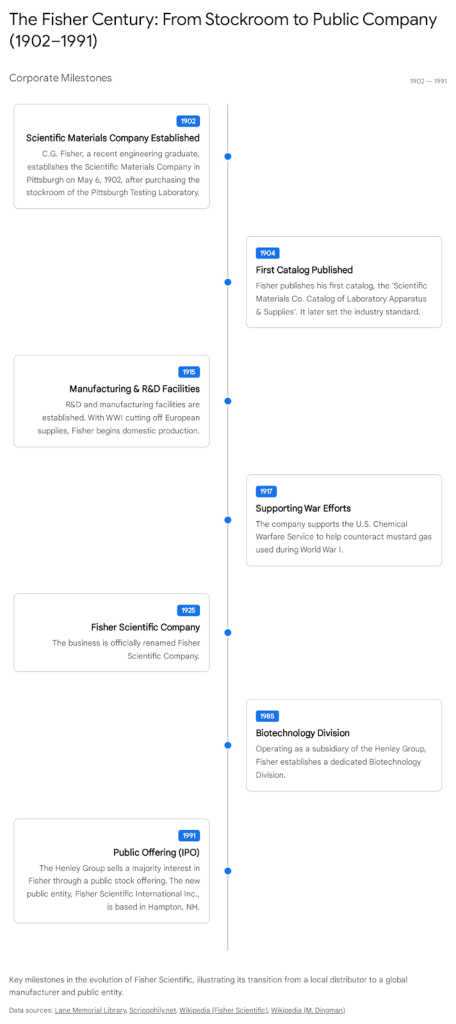
On May 6, 1902, C.G. Fisher purchased the stockroom of the Pittsburgh Testing Laboratory and established the “Scientific Materials Company”.1 This acquisition was the embryo of what would become Fisher Scientific. Fisher’s business model was not initially one of invention, but of aggregation and distribution—a “one-stop shop” mission that remains the core DNA of the Fisher channel today. By centralizing the supply chain, Fisher allowed industrial chemists to focus on analysis rather than procurement, effectively professionalizing the logistical side of American science.
The 1904 Catalog: The Bible of the Laboratory

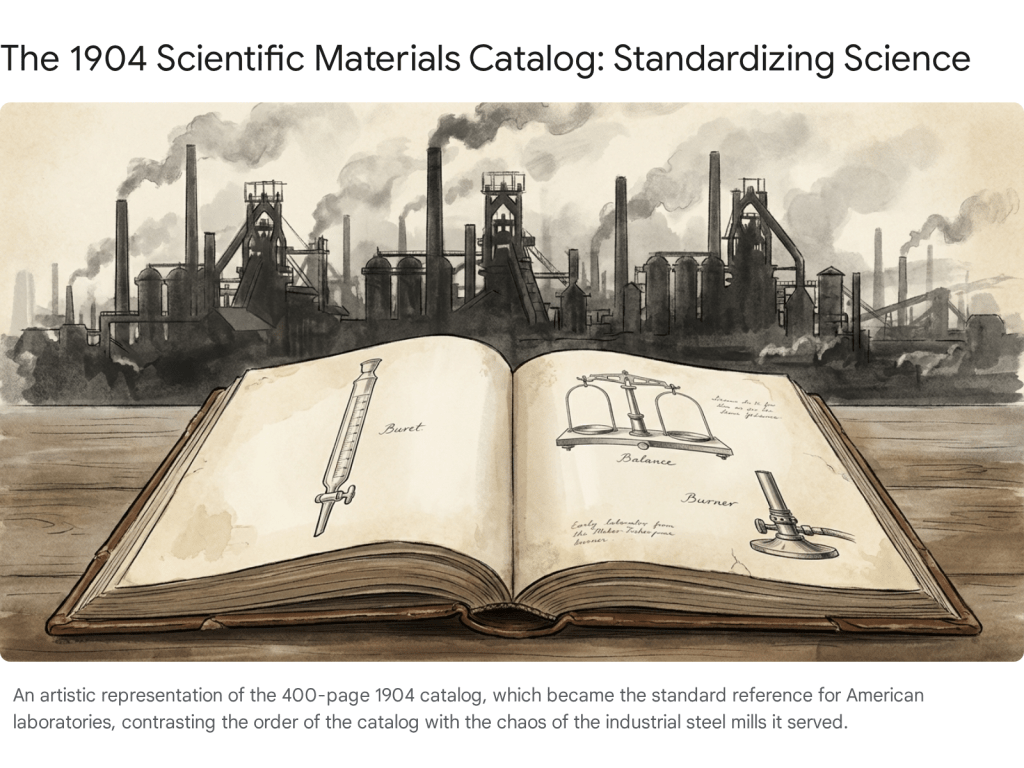
In 1904, two years after founding the company, Fisher published the Scientific Materials Co. Catalog of Laboratory Apparatus & Supplies.1 This 400-page tome was more than a simple sales list; it was a radical act of standardization. In an era before standardized parts, where a “clamp” or a “stand” could vary wildly between manufacturers, Fisher’s catalog defined what a “standard” pipette, buret, or balance looked like for the American scientist.2
The catalog became the primary interface between the scientific world and the marketplace. Later renamed simply The Fisher Catalog, it set the industry standard and became a recognized scientific reference tool worldwide, eventually being published in eight different languages.4 The strategic brilliance of the catalog lay in its ability to lock customers into the Fisher ecosystem. By assigning unique catalog numbers to specific apparatus configurations, Fisher ensured that when a laboratory manager ordered a replacement part, they ordered it from Fisher. This effectively created a “platform” business model decades before the term was coined in Silicon Valley.
Wartime Innovation and Supply Chain Sovereignty
The outbreak of World War I presented the young company with its first existential crisis and its greatest opportunity. Prior to the war, the global scientific community was heavily reliant on Europe—specifically Germany—as the primary source of high-quality optical glass, reagents, and precision instruments. As the war severed these supply lines, American laboratories faced a critical shortage of essential tools.4
Forced to innovate to survive, Fisher established its own Research & Development (R&D) and manufacturing facilities in 1915.1 The company’s role shifted from a pure distributor to a manufacturer-distributor hybrid. This vertical integration allowed Fisher to control the quality and availability of its products, a strategic advantage that would prove crucial in the decades to come.
In 1917, the company’s logistical capabilities were tested on a national stage. Fisher supported the U.S. Chemical Warfare Service in its efforts to counteract the mustard gas attacks used by the German army. Chester Fisher coordinated a massive logistical operation to round up “seven railroad carloads” of supplies to produce a complete field research laboratory for the American Expeditionary Force in France.1 This feat demonstrated that Fisher was not just a vendor, but a strategic partner capable of mobilizing resources for national security.
The Meker-Fisher Burner: Incremental Innovation
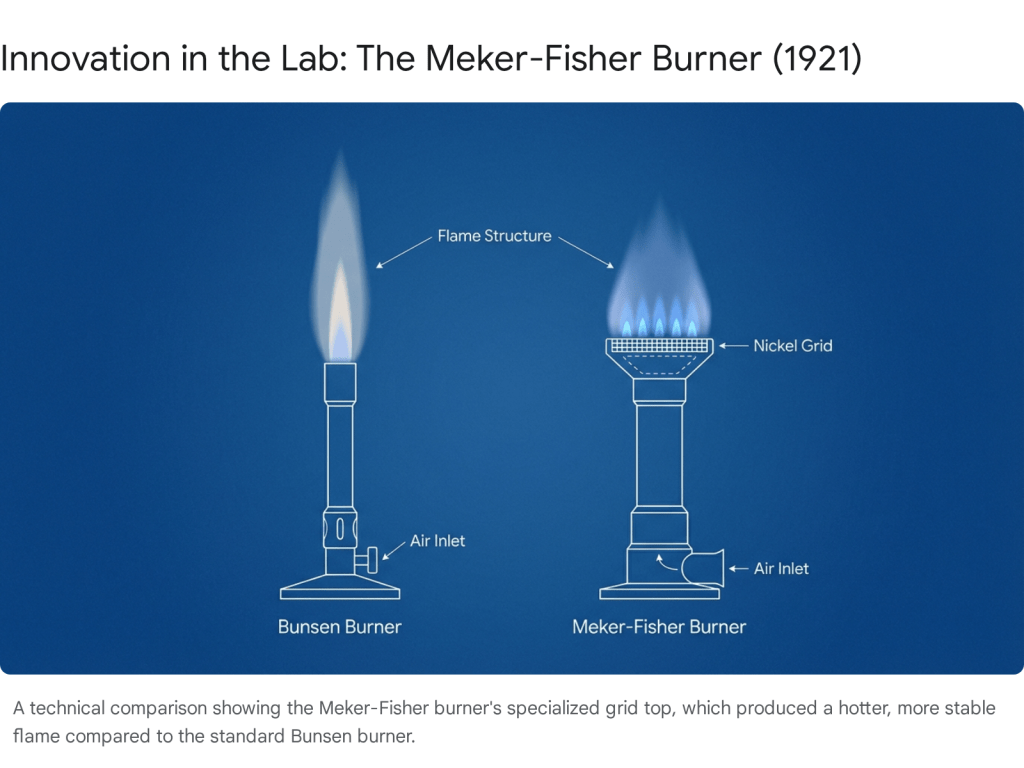
In 1921, the company introduced a product that exemplified its approach to innovation: the Meker-Fisher burner.1 Developed by Edwin Fisher, Chester’s brother, this device was a significant improvement over the standard Bunsen burner, which had been the laboratory standard since 1888. The traditional Bunsen burner often produced a flickering, uneven flame that was insufficient for the precise metallurgical analysis required by the steel industry.
Edwin Fisher’s design featured a deep nickel grid at the top of the burner tube and a larger air inlet. These modifications created a “short, intensely hot, homogeneous flame” that was far superior for high-temperature work.1 The Meker-Fisher burner was not a radical scientific breakthrough like the discovery of the electron; rather, it was a practical engineering fix that made the daily work of every chemist slightly more efficient. That philosophy—incremental, practical improvement delivered at scale—became the company’s ethos. In 1925, to distinguish itself from the many generic competitors springing up, the business was officially renamed the Fisher Scientific Company.1
The Alchemist Collection: A Cultural Legacy
A unique and often overlooked aspect of the Fisher history is its intersection with the world of fine art, which served a potent branding function. Chester Fisher was fascinated by the heritage of his customers—the chemists. He saw a direct lineage between the modern industrial chemist and the alchemists of the 17th century. To honor this connection, he began collecting Dutch and Flemish paintings depicting alchemists in their laboratories.5
Fisher acquired works by masters such as David Teniers the Younger and David Ryckaert III. His most famous acquisition was a painting titled The Alchemist, purchased in London in 1928.5 Fisher used reproductions of these paintings in his catalogs and marketing materials, effectively elevating the brand. By associating the often drab, industrial work of modern chemists with the mystical, noble pursuit of knowledge depicted in the paintings, Fisher provided his customers with a sense of professional dignity and historical continuity. This collection grew to be one of the largest of its kind in the world 7 and was eventually donated to the Chemical Heritage Foundation (now the Science History Institute).5 This cultural patronage reinforced the idea that Fisher Scientific was not merely a shop, but a custodian of the scientific tradition.
Chapter II: The Thermodynamics of Innovation — The Thermo Lineage (1956–1980)

George Hatsopoulos and the MIT Spin-out
While Fisher was perfecting the logistics of the stockroom in Pennsylvania, a different kind of scientific enterprise was taking shape in Massachusetts. In the mid-1950s, a Greek immigrant and MIT doctoral student named George Hatsopoulos was rewriting the rules of energy conversion in a garage in Belmont, Massachusetts.8
George Hatsopoulos was born in Athens in 1927 to a prominent family of professors and politicians. His early life was marked by the trauma and ingenuity of war; during the Nazi occupation of Athens in World War II, a teenage Hatsopoulos built radios from scavenged parts to provide the Greek resistance with access to BBC newscasts.9 This early experience with practical engineering under duress would characterize his later career. Following the war, he studied electrical engineering at Athens Polytechnic before moving to the United States to attend MIT, where he developed a deep fascination with thermodynamics—the science of energy and heat.10
In 1956, fresh with a PhD in mechanical engineering, Hatsopoulos founded Thermo Electron Corporation. The initial funding was a $50,000 loan provided by Peter Nomikos, a Harvard Business School graduate who believed in Hatsopoulos’s vision.10 The company’s original mission was high-minded and deeply technical: to develop direct energy conversion technologies, specifically thermionic energy conversion, which could turn heat directly into electricity without moving parts.10 This was a quintessential “deep tech” startup decades before the term existed, founded on the belief that fundamental laws of physics could be monetized.
Early Struggles and the Public Markets
Thermo Electron was not an overnight commercial success. Its core technology, while scientifically brilliant, was years ahead of its time and lacked immediate commercial applications. To survive, the company had to pivot and diversify. Thermo Electron went public in 1967 12, a move that provided the capital necessary to explore new applications for its thermodynamic expertise.
The company began to apply its knowledge of heat transfer and energy conversion to industrial problems. It developed systems for papermaking, metal processing, and environmental monitoring. Unlike Fisher, which grew by aggregating existing products, Thermo grew by inventing new ones. However, as the company expanded into diverse fields—from artificial hearts to bomb detectors—it faced a management challenge: how to maintain the entrepreneurial zeal of a startup within a growing conglomerate structure.
Chapter III: The Galaxy Strategy (1980–2000)
The Architecture of the Spin-out
In the 1980s, Hatsopoulos implemented a radical organizational strategy that would define Thermo Electron for three decades and become a case study in corporate finance. This strategy was known as the “spin-out.”
Unlike a traditional “spin-off,” where a parent company divests a business unit entirely to its shareholders to separate it from the core business, a spin-out involved Thermo Electron taking a specific technology division, incorporating it as a separate subsidiary, and selling a minority stake (typically around 10% to 20%) to the public via an Initial Public Offering (IPO), while retaining majority control.13
This structure created a “Thermo Galaxy,” with Thermo Electron as the sun and various subsidiaries orbiting it as publicly traded planets. The strategy was designed to solve three critical problems:
- Capital Raising: It allowed the company to raise cash for specific high-risk R&D projects (like the artificial heart) without diluting the parent company’s stock significantly. The subsidiary raised its own capital from investors who specifically wanted exposure to that technology.13
- Incentives: It solved the “big company” problem of diluted incentives. Managers of specific units (e.g., the environmental instrument division) were given stock options in their own subsidiary. This meant that their personal wealth was directly tied to the performance of their specific business, rather than being washed out by the average performance of a massive conglomerate.15 Hatsopoulos believed this replicated the hunger of a garage startup within a Fortune 500 company.
- Valuation: It attempted to eliminate the “conglomerate discount.” By having a market price for each piece of the empire, Hatsopoulos argued that the market would be forced to value the parent company as the sum of its parts, which was theoretically higher than the value of the whole.16
The Constellation of Subsidiaries
By the 1990s, the “Thermo Galaxy” had expanded into a bewildering array of public subsidiaries, creating a complex corporate ecosystem. Some of the key “planets” in this system included:
- Thermo Instrument Systems: Focused on analytical instruments for environmental and industrial monitoring.17
- Thermo Cardiosystems: Developing Left Ventricular Assist Devices (LVADs), essentially artificial hearts.10
- Thermo Ecotek: Dedicated to clean power generation and alternative energy projects.
- Thermo Fibertek: Focused on paper recycling and processing machinery.
- Thermo Trex: A high-tech subsidiary working on advanced physics, medical imaging (mammography), and defense applications like bomb detection.10
- Thermo BioAnalysis: A spin-out focused on the emerging field of bio-instrumentation.17
At its peak, the structure became fractal; subsidiaries would sometimes spin out their own subsidiaries (2nd and 3rd generation spin-outs), creating a web of cross-ownership and inter-company financing that was nearly impossible for an outsider to fully untangle.17
The Collapse of the Strategy: “One Thermo”
By the late 1990s, the spin-out strategy had become a victim of its own complexity. While it had successfully funded innovation for years, the structure was too convoluted for the average investor to understand. Wall Street began applying a heavy “conglomerate discount” because the transparency of the organization was low, and the administrative costs of maintaining dozens of public boards and filing separate SEC reports were high.16
Furthermore, the market environment had changed. The late 1990s were the era of the Dot-com bubble. Investors were chasing pure-play internet stocks and had little patience for complex industrial conglomerates with “sum of the parts” arguments. Thermo Electron’s stock price suffered as the market ignored the intrinsic value of its holdings.18
In 1998 and 1999, the Board, led by CEO Richard Syron (who succeeded Hatsopoulos), initiated the “One Thermo” restructuring strategy.19 This was a painful and expensive reversal of the previous twenty years. The plan involved:
- Privatizing the Spin-outs: Thermo Electron had to buy back the minority interests in its subsidiaries (e.g., ThermoSpectra, Thermo TerraTech) to consolidate them back under the parent company.18 This often involved paying a premium to the minority shareholders.
- Divesting Non-Core Assets: The company ruthlessly sold off businesses that did not fit the core mission of “instruments and life sciences.” Power generation, paper recycling, and other industrial businesses were divested.
- Rebranding: In 2000, the company initiated a master brand strategy. All remaining units were renamed with the prefix “Thermo” (e.g., Nicolet became Thermo Nicolet, Finnigan became Thermo Finnigan) to create a unified corporate identity.19
This restructuring transformed Thermo Electron from a chaotic holding company into a focused, integrated operating company. It laid the groundwork for the modern era by creating a streamlined entity that was ready for a transformative partnership.
Chapter IV: The Merchant of Science — Fisher’s Expansion (1950–2006)
The Henley Group Era and the 1991 IPO
While Thermo was experimenting with corporate structure, Fisher Scientific was undergoing its own transformation. For most of the 20th century, Fisher had remained a family-controlled entity. However, the corporate consolidation wave of the 1980s brought significant changes. The company was acquired and became a subsidiary of the Allied Corporation (later AlliedSignal). Subsequently, it was spun out into The Henley Group, a conglomerate run by Michael Dingman, a legendary corporate financier known as a “wheeler-dealer” operator who specialized in turning around undervalued industrial assets.3
Under Dingman’s stewardship, Fisher was groomed for the public markets. In 1991, The Henley Group sold a majority interest in Fisher Scientific through a public stock offering (IPO), listing it on the New York Stock Exchange under the ticker FSH.3 This marked the beginning of Fisher’s modern corporate era as an independent public company.
The Roll-Up Strategy
Following the IPO, Fisher embarked on an aggressive growth strategy under the leadership of CEO Paul Montrone (1991–2006) and CFO Paul Meister.21 The laboratory supply market in the 1990s was highly fragmented, consisting of hundreds of small, regional distributors. Montrone and Meister recognized that scale was the key to profitability in distribution.
They executed a “roll-up” strategy, completing over 60 acquisitions in a fifteen-year period.20 They bought regional competitors, specialized chemical suppliers, and niche equipment manufacturers. This consolidation spree transformed Fisher from a large American distributor into a global powerhouse with a massive logistical footprint. By the mid-2000s, Fisher Scientific was the dominant channel for scientific supplies, serving over 350,000 customers in 150 countries.3 They had perfected the art of the “one-stop shop,” but they lacked one critical component: high-end, proprietary technology. They were selling everyone else’s innovations, but owning very little of the intellectual property themselves.
Chapter V: The Fusion (2006)
The Strategic Rationale
In 2006, the trajectories of Thermo Electron and Fisher Scientific intersected. The logic for a combination was compelling, grounded in the concept of complementary strengths.
Thermo Electron was a powerhouse of high-end analytical instruments. They made the mass spectrometers, the chromatographs, and the elemental analyzers that were the “Ferraris” of the lab. However, these were one-time capital purchases. Once a lab bought a mass spectrometer, they might not buy another one for ten years. Thermo lacked a recurring revenue stream and a direct, high-frequency relationship with the customer.
Fisher Scientific, on the other hand, was the master of the channel. They sold the consumables—the pipette tips, the reagents, the glassware—that labs used every single day. They had the logistics network, the catalogs, and the deep customer relationships. However, they had low margins compared to high-tech instrument makers.
The proposed merger promised “synergy” in its truest form. Thermo’s high-margin instruments could be pushed through Fisher’s deep distribution channels. Conversely, Fisher’s consumables could be bundled with Thermo’s instruments, creating a sticky ecosystem. If a lab bought a Thermo instrument, the goal was to ensure they ran Fisher reagents through it for its entire lifecycle.
The Merger of Equals
On May 8, 2006, the two companies announced a “merger of equals”.22 The deal was structured as a tax-free, stock-for-stock exchange. Fisher shareholders received 2.00 shares of Thermo Electron common stock for each share of Fisher stock they owned.11 This valuation reflected the massive scale Fisher had achieved through its roll-up strategy.
The combined entity was projected to have more than $9 billion in revenues and $1 billion in cash flow in its first year.22 The deal closed on November 9, 2006, creating Thermo Fisher Scientific Inc. (NYSE: TMO). The ticker symbol TMO was retained, honoring the Thermo lineage, but the Fisher name took equal billing in the corporate identity, acknowledging the power of the Fisher brand in the marketplace.
Chapter VI: The Inorganic Engine (2006–2020)
Marc Casper and the Capital Allocation Machine
Post-merger, the leadership mantle eventually passed to Marc Casper, who became CEO in 2009. Under Casper, TMO became one of the most effective capital allocators in the S&P 500. The strategy was simple to describe but difficult to execute: use the strong, reliable cash flow from the base business (boosted by Fisher’s recurring consumables revenue) to acquire high-growth assets, plug them into the unrivaled Fisher distribution channel, and ruthlessly strip out costs through the “PPI Business System” (Practical Process Improvement).
The company embarked on a series of massive acquisitions that fundamentally altered its scope, moving it from an instrument and supply company to a dominant force in life sciences, genomics, and clinical services.
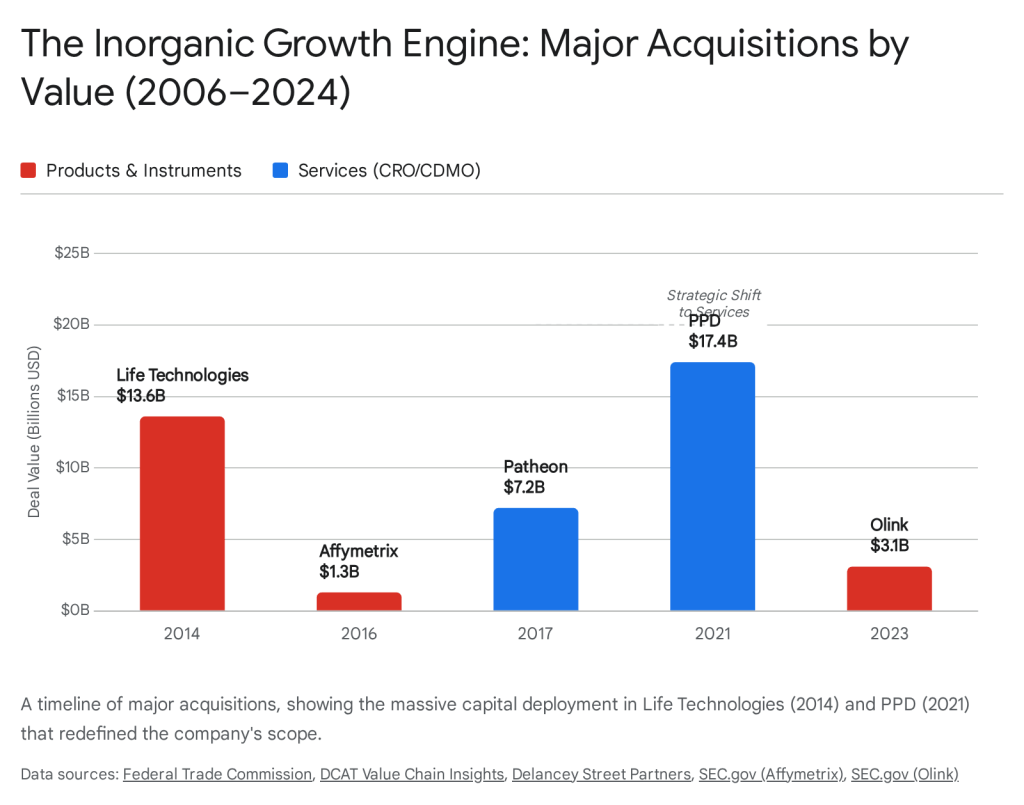
1. Life Technologies (2014) — $13.6 Billion
The acquisition of Life Technologies in 2014 was a transformative moment. Life Technologies itself was the product of a merger between Invitrogen and Applied Biosystems. By acquiring it for $13.6 billion, Thermo Fisher gained immediate dominance in the field of genomics.23
Life Technologies owned the Applied Biosystems brand, which was synonymous with DNA sequencing and PCR (Polymerase Chain Reaction) machines. It also owned Invitrogen, a leader in reagents and cellular analysis. This deal positioned TMO at the very center of the genomic revolution, providing the tools for the next generation of personalized medicine. The deal was so significant that the Federal Trade Commission (FTC) required TMO to divest its gene modulation and cell culture media businesses (selling them to GE Healthcare) to avoid creating a monopoly.23
2. FEI Company (2016) — $4.2 Billion
In 2016, TMO acquired FEI Company for approximately $4.2 billion.25 FEI was the global leader in electron microscopy. This was a strategic bet on the field of structural biology.
FEI’s Cryo-electron microscopy (Cryo-EM) technology allowed scientists to visualize protein structures at near-atomic resolution without crystallization. This technology was becoming essential for drug discovery, allowing pharmaceutical companies to map the structures of viruses and drug targets with unprecedented clarity. By acquiring FEI, TMO essentially bought a monopoly on the high-end microscope market, further entrenching itself in the drug discovery workflow.26
3. Patheon (2017) — $7.2 Billion
The 2017 acquisition of Patheon for $7.2 billion marked a significant strategic pivot into services.27 Patheon was a Contract Development and Manufacturing Organization (CDMO).
Historically, TMO sold the tools to make the drugs. With Patheon, TMO could now manufacture the drugs for the client. This vertical integration meant TMO could capture value across the entire lifecycle of a pharmaceutical product. A biotech startup could discover a drug using Thermo instruments, develop it using Fisher reagents, and then hire Thermo Fisher (via Patheon) to manufacture the pills or vials for clinical trials and commercial sale. This “end-to-end” proposition was unique in the industry.
Chapter VII: The Pandemic Pivot (2020–2022)
The “Arms Dealer” of the Pandemic
The COVID-19 pandemic was a defining moment for Thermo Fisher Scientific, testing the resilience and agility of the massive conglomerate. The company effectively became the “arms dealer” for the global pandemic response, supplying the essential tools required to fight the virus on multiple fronts.
When the virus genome was sequenced, Thermo Fisher mobilized its Life Technologies division to produce the TaqPath COVID-19 Combo Kit. This PCR-based test became the gold standard for detection globally.29 The company ramped up production of PCR machines, reagents, and plastics (pipette tips became as valuable as gold) to meet insatiable demand.
Simultaneously, its Patheon manufacturing division secured contracts to manufacture vaccines for major pharmaceutical players like Moderna and Pfizer.30 Thermo Fisher was thus profiting from both the diagnosis of the disease and the manufacturing of the cure.
The Financial Windfall and the PPD Acquisition
The financial impact was staggering. In the fourth quarter of 2020 alone, the company generated $3.2 billion in COVID-19 response revenue.29 This massive influx of cash provided the company with a war chest that it immediately sought to deploy.
Rather than issuing a special dividend or purely buying back stock, TMO stuck to its long-term strategy of M&A. In 2021, it announced its largest acquisition to date: the purchase of PPD, Inc. for $17.4 billion.31
PPD was a leading Contract Research Organization (CRO), a company that manages clinical trials for pharmaceutical companies. With this acquisition, TMO closed the final gap in its service offering. The “flywheel” was now complete:
- Discover: Using Thermo instruments and Life Tech genomics.
- Develop: Using Fisher supplies and reagents.
- Test: Managing clinical trials via PPD.
- Manufacture: Producing the commercial drug via Patheon.
This acquisition cemented Thermo Fisher’s position as the indispensable partner to the biopharma industry.
Chapter VIII: The New Frontier (2023–Present)
Navigating the “Covid Cliff”
As the pandemic subsided in 2022 and 2023, TMO faced what investors called the “Covid Cliff”—the sharp decline in testing revenue. However, the company successfully navigated this transition by focusing on its “base business” (non-COVID revenue). While testing revenue evaporated, the core business grew at double-digit rates, proving that the relationships formed during the pandemic were sticky and that the capital deployed into PPD was generating new growth engines.33
Olink and the Proteomics Push
In late 2023, Thermo Fisher announced the acquisition of Olink Holding AB for approximately $3.1 billion, a deal that closed in July 2024.35 Olink specializes in proteomics—the study of proteins. While genomics (DNA) tells you what could happen, proteomics tells you what is happening in the body. It is widely considered the next frontier in precision medicine.
Olink’s technology, specifically its Proximity Extension Assay (PEA), allows for the high-throughput analysis of protein biomarkers. This acquisition complements the massive installed base of Thermo mass spectrometers and PCR machines, positioning the company to lead the next wave of biological discovery.
Financial Performance: A Legacy of Compounding
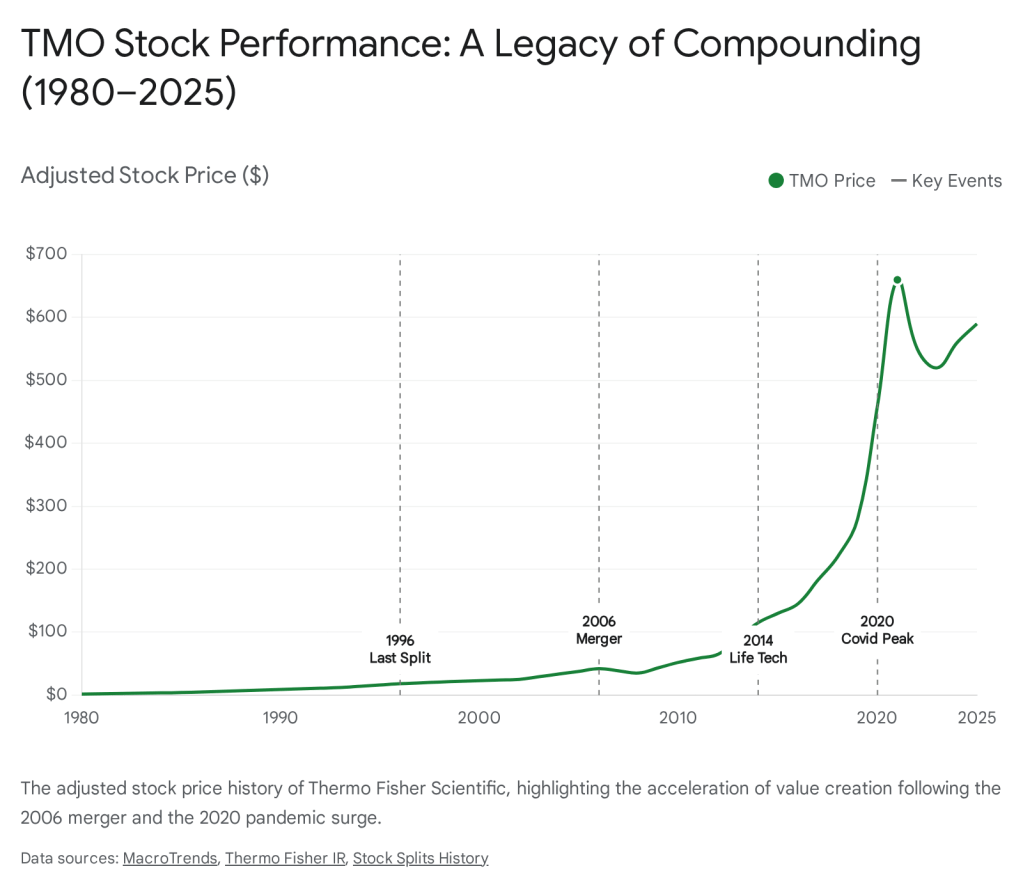
The financial history of Thermo Fisher Scientific is a testament to the power of compounding. The company’s stock has been a perennial outperformer.
Stock Splits: Before the 2006 merger, the legacy Thermo Electron company frequently split its stock to maintain liquidity, with 3-for-2 splits occurring in 1983, 1985, 1986, 1993, 1995, and 1996.37 Notably, there have been no stock splits since 1996. The modern management team appears to view a high share price (trading often above $500 in recent years) as a badge of quality and institutional stability, eschewing the retail-friendly tactics of frequent splits.
Dividends: The company initiated a dividend program which has grown consistently. As of the 2024/2025 period, the company has increased its dividend for 9 consecutive years.39 However, the yield remains low (typically less than 0.5%), as the company continues to prioritize capital appreciation and aggressive M&A over income generation. The retained earnings are viewed as fuel for the next acquisition, a strategy that shareholders have largely endorsed given the company’s track record of successful integration.
Recent Financials: For the full year 2025, Thermo Fisher reported revenue of $44.56 billion, a 4% increase from the previous year, with adjusted earnings per share (EPS) of $22.87.41 These figures underscore the massive scale the company has achieved—from a $50,000 loan in a garage to a $45 billion annual revenue engine.
Epilogue: The Silent Infrastructure
The history of Thermo Fisher Scientific is a study in the evolution of scientific capital. It began with two distinct threads: Chester Fisher’s recognition that science needs a supply chain, and George Hatsopoulos’s belief that science can be a business.
For the first century, these threads ran parallel. Fisher built the catalog; Thermo built the instruments. Their convergence in 2006 created a unique entity that defies the traditional boundaries of the sector. It is neither just a manufacturer nor just a distributor. It is the infrastructure of science itself.
Today, with a market capitalization often exceeding $200 billion and a presence in almost every laboratory on Earth, TMO stands as a testament to the power of the “pick-and-shovel” strategy. While pharmaceutical companies bet billions on the binary outcome of a single drug trial, Thermo Fisher bets on the process of discovery itself. It is a wager that, for 120 years, has rarely failed to pay off.
Appendix A: Key Biographical Figures
| Figure | Role | Key Contribution |
| Chester Garfield Fisher | Founder, Fisher Scientific | Established the “stockroom” model; created the 1904 catalog; pioneered the standardizing of lab equipment; art collector who defined the brand’s cultural legacy. |
| George Hatsopoulos | Founder, Thermo Electron | MIT PhD and Greek resistance fighter; pioneered the “spin-out” strategy; focused company on thermodynamics and instrumentation; defined the engineering culture. |
| Paul Montrone | CEO, Fisher Scientific | Led Fisher’s aggressive consolidation (60+ acquisitions) in the 1990s and architected the 2006 merger of equals. |
| Marc Casper | CEO, Thermo Fisher (2009–) | Architect of the modern “M&A Machine” (Life Tech, FEI, PPD) and the Covid-19 pivot; defined the current “Customer Channel” strategy. |
Appendix B: The Alchemist in Art
The Fisher collection of alchemical art serves as a fascinating window into the company’s corporate soul. While modern science prides itself on rationality, Chester Fisher understood that the impulse to discover—the drive to turn base matter into gold, or sickness into health—remains unchanged. By surrounding his employees and customers with images of Teniers’ alchemists, he reminded them that they were part of a lineage that stretched back centuries. The specific painting The Alchemist by David Teniers the Younger, acquired in 1928, depicts an alchemist working bellows at a furnace—a direct visual parallel to the Meker-Fisher burners that Fisher was manufacturing in Pittsburgh. This visual continuity helped elevate the brand from a commodity supplier to a partner in the great human endeavor of discovery.
The Evolution of Scientific Capital: A Definitive History of Thermo Fisher Scientific (NYSE: TMO)
Prologue: The Convergence of Matter and Energy
The history of Thermo Fisher Scientific is not merely a chronicle of corporate mergers and stock tickers; it is a proxy for the evolution of the American scientific industrial complex over the last century. From the soot-stained steel mills of Pittsburgh in 1902 to the genomic frontiers of the 21st century, the entity now known as Thermo Fisher Scientific has served as the silent infrastructure of discovery. It represents the successful fusion of two distinct, and at times contradictory, corporate philosophies: the “Fisher” lineage—a pragmatic, catalog-driven merchandising empire built on the tangible needs of the industrial chemist—and the “Thermo” lineage—an MIT-born, intellectual property-driven incubator founded on the abstract principles of thermodynamics.
The merger of these two entities in 2006 created a colossus that defied the typical “conglomerate discount,” building instead a “flywheel of serving science” that capitalizes on every stage of the research lifecycle. To understand the $170 billion titan that exists today, one must first deconstruct the parallel histories of its progenitors, exploring how a stockroom in Pittsburgh and a garage in Belmont, Massachusetts, evolved to control the supply chain of global science.
Chapter I: The Crucible of Industry — The Fisher Lineage (1902–1950)
The Pittsburgh Context and the Birth of the “Stockroom”
The genesis of the Fisher side of the ledger dates to the dawn of the 20th century in Pittsburgh, Pennsylvania, a city then serving as the crucible of American industrial power. In 1902, the steel industry was voracious, not just for iron ore and coal, but for the chemical verification of its products. As America transitioned from an agrarian society to an industrial superpower, quality control was moving from the artisan’s eye to the chemist’s bench. The burgeoning steel factories, coal mines, and manufacturing plants of western Pennsylvania required rigorous testing to ensure the structural integrity of the materials building the nation’s skyscrapers and railroads.
However, the infrastructure to support this scientific booming was nonexistent. Chester Garfield Fisher, a twenty-year-old engineering graduate from the Western University of Pennsylvania (now the University of Pittsburgh), recognized a critical bottleneck in this industrial boom. The laboratories testing the steel and coal lacked a reliable, centralized commercial source for equipment and reagents. Laboratories were forced to source beakers from glassblowers, chemicals from apothecaries, and precision instruments from Europe, often with months of lead time.
On May 6, 1902, C.G. Fisher purchased the stockroom of the Pittsburgh Testing Laboratory and established the “Scientific Materials Company”. This acquisition was the embryo of what would become Fisher Scientific. Fisher’s business model was not initially one of invention, but of aggregation and distribution—a “one-stop shop” mission that remains the core DNA of the Fisher channel today. By centralizing the supply chain, Fisher allowed industrial chemists to focus on analysis rather than procurement, effectively professionalizing the logistical side of American science.
The 1904 Catalog: The Bible of the Laboratory
In 1904, two years after founding the company, Fisher published the Scientific Materials Co. Catalog of Laboratory Apparatus & Supplies. This 400-page tome was more than a simple sales list; it was a radical act of standardization. In an era before standardized parts, where a “clamp” or a “stand” could vary wildly between manufacturers, Fisher’s catalog defined what a “standard” pipette, buret, or balance looked like for the American scientist.
The catalog became the primary interface between the scientific world and the marketplace. Later renamed simply The Fisher Catalog, it set the industry standard and became a recognized scientific reference tool worldwide, eventually being published in eight different languages. The strategic brilliance of the catalog lay in its ability to lock customers into the Fisher ecosystem. By assigning unique catalog numbers to specific apparatus configurations, Fisher ensured that when a laboratory manager ordered a replacement part, they ordered it from Fisher. This effectively created a “platform” business model decades before the term was coined in Silicon Valley.
Wartime Innovation and Supply Chain Sovereignty
The outbreak of World War I presented the young company with its first existential crisis and its greatest opportunity. Prior to the war, the global scientific community was heavily reliant on Europe—specifically Germany—as the primary source of high-quality optical glass, reagents, and precision instruments. As the war severed these supply lines, American laboratories faced a critical shortage of essential tools.
Forced to innovate to survive, Fisher established its own Research & Development (R&D) and manufacturing facilities in 1915. The company’s role shifted from a pure distributor to a manufacturer-distributor hybrid. This vertical integration allowed Fisher to control the quality and availability of its products, a strategic advantage that would prove crucial in the decades to come.
In 1917, the company’s logistical capabilities were tested on a national stage. Fisher supported the U.S. Chemical Warfare Service in its efforts to counteract the mustard gas attacks used by the German army. Chester Fisher coordinated a massive logistical operation to round up “seven railroad carloads” of supplies to produce a complete field research laboratory for the American Expeditionary Force in France. This feat demonstrated that Fisher was not just a vendor, but a strategic partner capable of mobilizing resources for national security.
The Meker-Fisher Burner: Incremental Innovation
In 1921, the company introduced a product that exemplified its approach to innovation: the Meker-Fisher burner.Developed by Edwin Fisher, Chester’s brother, this device was a significant improvement over the standard Bunsen burner, which had been the laboratory standard since 1888. The traditional Bunsen burner often produced a flickering, uneven flame that was insufficient for the precise metallurgical analysis required by the steel industry.
Edwin Fisher’s design featured a deep nickel grid at the top of the burner tube and a larger air inlet. These modifications created a “short, intensely hot, homogeneous flame” that was far superior for high-temperature work. The Meker-Fisher burner was not a radical scientific breakthrough like the discovery of the electron; rather, it was a practical engineering fix that made the daily work of every chemist slightly more efficient. That philosophy—incremental, practical improvement delivered at scale—became the company’s ethos. In 1925, to distinguish itself from the many generic competitors springing up, the business was officially renamed the Fisher Scientific Company.
The Alchemist Collection: A Cultural Legacy
A unique and often overlooked aspect of the Fisher history is its intersection with the world of fine art, which served a potent branding function. Chester Fisher was fascinated by the heritage of his customers—the chemists. He saw a direct lineage between the modern industrial chemist and the alchemists of the 17th century. To honor this connection, he began collecting Dutch and Flemish paintings depicting alchemists in their laboratories.
Fisher acquired works by masters such as David Teniers the Younger and David Ryckaert III. His most famous acquisition was a painting titled The Alchemist, purchased in London in 1928. Fisher used reproductions of these paintings in his catalogs and marketing materials, effectively elevating the brand. By associating the often drab, industrial work of modern chemists with the mystical, noble pursuit of knowledge depicted in the paintings, Fisher provided his customers with a sense of professional dignity and historical continuity. This collection grew to be one of the largest of its kind in the world and was eventually donated to the Chemical Heritage Foundation (now the Science History Institute). This cultural patronage reinforced the idea that Fisher Scientific was not merely a shop, but a custodian of the scientific tradition.
Chapter II: The Thermodynamics of Innovation — The Thermo Lineage (1956–1980)
George Hatsopoulos and the MIT Spin-out
While Fisher was perfecting the logistics of the stockroom in Pennsylvania, a different kind of scientific enterprise was taking shape in Massachusetts. In the mid-1950s, a Greek immigrant and MIT doctoral student named George Hatsopoulos was rewriting the rules of energy conversion in a garage in Belmont, Massachusetts.
George Hatsopoulos was born in Athens in 1927 to a prominent family of professors and politicians. His early life was marked by the trauma and ingenuity of war; during the Nazi occupation of Athens in World War II, a teenage Hatsopoulos built radios from scavenged parts to provide the Greek resistance with access to BBC newscasts. This early experience with practical engineering under duress would characterize his later career. Following the war, he studied electrical engineering at Athens Polytechnic before moving to the United States to attend MIT, where he developed a deep fascination with thermodynamics—the science of energy and heat.
In 1956, fresh with a PhD in mechanical engineering, Hatsopoulos founded Thermo Electron Corporation. The initial funding was a $50,000 loan provided by Peter Nomikos, a Harvard Business School graduate who believed in Hatsopoulos’s vision. The company’s original mission was high-minded and deeply technical: to develop direct energy conversion technologies, specifically thermionic energy conversion, which could turn heat directly into electricity without moving parts. This was a quintessential “deep tech” startup decades before the term existed, founded on the belief that fundamental laws of physics could be monetized.
Early Struggles and the Public Markets
Thermo Electron was not an overnight commercial success. Its core technology, while scientifically brilliant, was years ahead of its time and lacked immediate commercial applications. To survive, the company had to pivot and diversify. Thermo Electron went public in 1967 , a move that provided the capital necessary to explore new applications for its thermodynamic expertise.
The company began to apply its knowledge of heat transfer and energy conversion to industrial problems. It developed systems for papermaking, metal processing, and environmental monitoring. Unlike Fisher, which grew by aggregating existing products, Thermo grew by inventing new ones. However, as the company expanded into diverse fields—from artificial hearts to bomb detectors—it faced a management challenge: how to maintain the entrepreneurial zeal of a startup within a growing conglomerate structure.
Chapter III: The Galaxy Strategy (1980–2000)
The Architecture of the Spin-out
In the 1980s, Hatsopoulos implemented a radical organizational strategy that would define Thermo Electron for three decades and become a case study in corporate finance. This strategy was known as the “spin-out.”
Unlike a traditional “spin-off,” where a parent company divests a business unit entirely to its shareholders to separate it from the core business, a spin-out involved Thermo Electron taking a specific technology division, incorporating it as a separate subsidiary, and selling a minority stake (typically around 10% to 20%) to the public via an Initial Public Offering (IPO), while retaining majority control.
This structure created a “Thermo Galaxy,” with Thermo Electron as the sun and various subsidiaries orbiting it as publicly traded planets. The strategy was designed to solve three critical problems:
- Capital Raising: It allowed the company to raise cash for specific high-risk R&D projects (like the artificial heart) without diluting the parent company’s stock significantly. The subsidiary raised its own capital from investors who specifically wanted exposure to that technology.
- Incentives: It solved the “big company” problem of diluted incentives. Managers of specific units (e.g., the environmental instrument division) were given stock options in their own subsidiary. This meant that their personal wealth was directly tied to the performance of their specific business, rather than being washed out by the average performance of a massive conglomerate. Hatsopoulos believed this replicated the hunger of a garage startup within a Fortune 500 company.
- Valuation: It attempted to eliminate the “conglomerate discount.” By having a market price for each piece of the empire, Hatsopoulos argued that the market would be forced to value the parent company as the sum of its parts, which was theoretically higher than the value of the whole.
The Constellation of Subsidiaries
By the 1990s, the “Thermo Galaxy” had expanded into a bewildering array of public subsidiaries, creating a complex corporate ecosystem. Some of the key “planets” in this system included:
- Thermo Instrument Systems: Focused on analytical instruments for environmental and industrial monitoring.
- Thermo Cardiosystems: Developing Left Ventricular Assist Devices (LVADs), essentially artificial hearts.
- Thermo Ecotek: Dedicated to clean power generation and alternative energy projects.
- Thermo Fibertek: Focused on paper recycling and processing machinery.
- Thermo Trex: A high-tech subsidiary working on advanced physics, medical imaging (mammography), and defense applications like bomb detection.
- Thermo BioAnalysis: A spin-out focused on the emerging field of bio-instrumentation.
At its peak, the structure became fractal; subsidiaries would sometimes spin out their own subsidiaries (2nd and 3rd generation spin-outs), creating a web of cross-ownership and inter-company financing that was nearly impossible for an outsider to fully untangle.
The Collapse of the Strategy: “One Thermo”
By the late 1990s, the spin-out strategy had become a victim of its own complexity. While it had successfully funded innovation for years, the structure was too convoluted for the average investor to understand. Wall Street began applying a heavy “conglomerate discount” because the transparency of the organization was low, and the administrative costs of maintaining dozens of public boards and filing separate SEC reports were high.
Furthermore, the market environment had changed. The late 1990s were the era of the Dot-com bubble. Investors were chasing pure-play internet stocks and had little patience for complex industrial conglomerates with “sum of the parts” arguments. Thermo Electron’s stock price suffered as the market ignored the intrinsic value of its holdings.
In 1998 and 1999, the Board, led by CEO Richard Syron (who succeeded Hatsopoulos), initiated the “One Thermo” restructuring strategy. This was a painful and expensive reversal of the previous twenty years. The plan involved:
- Privatizing the Spin-outs: Thermo Electron had to buy back the minority interests in its subsidiaries (e.g., ThermoSpectra, Thermo TerraTech) to consolidate them back under the parent company. This often involved paying a premium to the minority shareholders.
- Divesting Non-Core Assets: The company ruthlessly sold off businesses that did not fit the core mission of “instruments and life sciences.” Power generation, paper recycling, and other industrial businesses were divested.
- Rebranding: In 2000, the company initiated a master brand strategy. All remaining units were renamed with the prefix “Thermo” (e.g., Nicolet became Thermo Nicolet, Finnigan became Thermo Finnigan) to create a unified corporate identity.
This restructuring transformed Thermo Electron from a chaotic holding company into a focused, integrated operating company. It laid the groundwork for the modern era by creating a streamlined entity that was ready for a transformative partnership.
Chapter IV: The Merchant of Science — Fisher’s Expansion (1950–2006)
The Henley Group Era and the 1991 IPO
While Thermo was experimenting with corporate structure, Fisher Scientific was undergoing its own transformation. For most of the 20th century, Fisher had remained a family-controlled entity. However, the corporate consolidation wave of the 1980s brought significant changes. The company was acquired and became a subsidiary of the Allied Corporation (later AlliedSignal). Subsequently, it was spun out into The Henley Group, a conglomerate run by Michael Dingman, a legendary corporate financier known as a “wheeler-dealer” operator who specialized in turning around undervalued industrial assets.
Under Dingman’s stewardship, Fisher was groomed for the public markets. In 1991, The Henley Group sold a majority interest in Fisher Scientific through a public stock offering (IPO), listing it on the New York Stock Exchange under the ticker FSH. This marked the beginning of Fisher’s modern corporate era as an independent public company.
The Roll-Up Strategy
Following the IPO, Fisher embarked on an aggressive growth strategy under the leadership of CEO Paul Montrone (1991–2006) and CFO Paul Meister. The laboratory supply market in the 1990s was highly fragmented, consisting of hundreds of small, regional distributors. Montrone and Meister recognized that scale was the key to profitability in distribution.
They executed a “roll-up” strategy, completing over 60 acquisitions in a fifteen-year period. They bought regional competitors, specialized chemical suppliers, and niche equipment manufacturers. This consolidation spree transformed Fisher from a large American distributor into a global powerhouse with a massive logistical footprint. By the mid-2000s, Fisher Scientific was the dominant channel for scientific supplies, serving over 350,000 customers in 150 countries. They had perfected the art of the “one-stop shop,” but they lacked one critical component: high-end, proprietary technology. They were selling everyone else’s innovations, but owning very little of the intellectual property themselves.
Chapter V: The Fusion (2006)
The Strategic Rationale
In 2006, the trajectories of Thermo Electron and Fisher Scientific intersected. The logic for a combination was compelling, grounded in the concept of complementary strengths.
Thermo Electron was a powerhouse of high-end analytical instruments. They made the mass spectrometers, the chromatographs, and the elemental analyzers that were the “Ferraris” of the lab. However, these were one-time capital purchases. Once a lab bought a mass spectrometer, they might not buy another one for ten years. Thermo lacked a recurring revenue stream and a direct, high-frequency relationship with the customer.
Fisher Scientific, on the other hand, was the master of the channel. They sold the consumables—the pipette tips, the reagents, the glassware—that labs used every single day. They had the logistics network, the catalogs, and the deep customer relationships. However, they had low margins compared to high-tech instrument makers.
The proposed merger promised “synergy” in its truest form. Thermo’s high-margin instruments could be pushed through Fisher’s deep distribution channels. Conversely, Fisher’s consumables could be bundled with Thermo’s instruments, creating a sticky ecosystem. If a lab bought a Thermo instrument, the goal was to ensure they ran Fisher reagents through it for its entire lifecycle.
The Merger of Equals
On May 8, 2006, the two companies announced a “merger of equals”. The deal was structured as a tax-free, stock-for-stock exchange. Fisher shareholders received 2.00 shares of Thermo Electron common stock for each share of Fisher stock they owned. This valuation reflected the massive scale Fisher had achieved through its roll-up strategy.
The combined entity was projected to have more than $9 billion in revenues and $1 billion in cash flow in its first year.The deal closed on November 9, 2006, creating Thermo Fisher Scientific Inc. (NYSE: TMO). The ticker symbol TMO was retained, honoring the Thermo lineage, but the Fisher name took equal billing in the corporate identity, acknowledging the power of the Fisher brand in the marketplace.
Chapter VI: The Inorganic Engine (2006–2020)
Marc Casper and the Capital Allocation Machine
Post-merger, the leadership mantle eventually passed to Marc Casper, who became CEO in 2009. Under Casper, TMO became one of the most effective capital allocators in the S&P 500. The strategy was simple to describe but difficult to execute: use the strong, reliable cash flow from the base business (boosted by Fisher’s recurring consumables revenue) to acquire high-growth assets, plug them into the unrivaled Fisher distribution channel, and ruthlessly strip out costs through the “PPI Business System” (Practical Process Improvement).
The company embarked on a series of massive acquisitions that fundamentally altered its scope, moving it from an instrument and supply company to a dominant force in life sciences, genomics, and clinical services.
1. Life Technologies (2014) — $13.6 Billion
The acquisition of Life Technologies in 2014 was a transformative moment. Life Technologies itself was the product of a merger between Invitrogen and Applied Biosystems. By acquiring it for $13.6 billion, Thermo Fisher gained immediate dominance in the field of genomics.
Life Technologies owned the Applied Biosystems brand, which was synonymous with DNA sequencing and PCR (Polymerase Chain Reaction) machines. It also owned Invitrogen, a leader in reagents and cellular analysis. This deal positioned TMO at the very center of the genomic revolution, providing the tools for the next generation of personalized medicine. The deal was so significant that the Federal Trade Commission (FTC) required TMO to divest its gene modulation and cell culture media businesses (selling them to GE Healthcare) to avoid creating a monopoly.
2. FEI Company (2016) — $4.2 Billion
In 2016, TMO acquired FEI Company for approximately $4.2 billion. FEI was the global leader in electron microscopy. This was a strategic bet on the field of structural biology.
FEI’s Cryo-electron microscopy (Cryo-EM) technology allowed scientists to visualize protein structures at near-atomic resolution without crystallization. This technology was becoming essential for drug discovery, allowing pharmaceutical companies to map the structures of viruses and drug targets with unprecedented clarity. By acquiring FEI, TMO essentially bought a monopoly on the high-end microscope market, further entrenching itself in the drug discovery workflow.
3. Patheon (2017) — $7.2 Billion
The 2017 acquisition of Patheon for $7.2 billion marked a significant strategic pivot into services. Patheon was a Contract Development and Manufacturing Organization (CDMO).
Historically, TMO sold the tools to make the drugs. With Patheon, TMO could now manufacture the drugs for the client. This vertical integration meant TMO could capture value across the entire lifecycle of a pharmaceutical product. A biotech startup could discover a drug using Thermo instruments, develop it using Fisher reagents, and then hire Thermo Fisher (via Patheon) to manufacture the pills or vials for clinical trials and commercial sale. This “end-to-end” proposition was unique in the industry.
Chapter VII: The Pandemic Pivot (2020–2022)
The “Arms Dealer” of the Pandemic
The COVID-19 pandemic was a defining moment for Thermo Fisher Scientific, testing the resilience and agility of the massive conglomerate. The company effectively became the “arms dealer” for the global pandemic response, supplying the essential tools required to fight the virus on multiple fronts.
When the virus genome was sequenced, Thermo Fisher mobilized its Life Technologies division to produce the TaqPath COVID-19 Combo Kit. This PCR-based test became the gold standard for detection globally. The company ramped up production of PCR machines, reagents, and plastics (pipette tips became as valuable as gold) to meet insatiable demand.
Simultaneously, its Patheon manufacturing division secured contracts to manufacture vaccines for major pharmaceutical players like Moderna and Pfizer. Thermo Fisher was thus profiting from both the diagnosis of the disease and the manufacturing of the cure.
The Financial Windfall and the PPD Acquisition
The financial impact was staggering. In the fourth quarter of 2020 alone, the company generated $3.2 billion in COVID-19 response revenue. This massive influx of cash provided the company with a war chest that it immediately sought to deploy.
Rather than issuing a special dividend or purely buying back stock, TMO stuck to its long-term strategy of M&A. In 2021, it announced its largest acquisition to date: the purchase of PPD, Inc. for $17.4 billion.
PPD was a leading Contract Research Organization (CRO), a company that manages clinical trials for pharmaceutical companies. With this acquisition, TMO closed the final gap in its service offering. The “flywheel” was now complete:
- Discover: Using Thermo instruments and Life Tech genomics.
- Develop: Using Fisher supplies and reagents.
- Test: Managing clinical trials via PPD.
- Manufacture: Producing the commercial drug via Patheon.
This acquisition cemented Thermo Fisher’s position as the indispensable partner to the biopharma industry.
Chapter VIII: The New Frontier (2023–Present)
Navigating the “Covid Cliff”
As the pandemic subsided in 2022 and 2023, TMO faced what investors called the “Covid Cliff”—the sharp decline in testing revenue. However, the company successfully navigated this transition by focusing on its “base business” (non-COVID revenue). While testing revenue evaporated, the core business grew at double-digit rates, proving that the relationships formed during the pandemic were sticky and that the capital deployed into PPD was generating new growth engines.
Olink and the Proteomics Push
In late 2023, Thermo Fisher announced the acquisition of Olink Holding AB for approximately $3.1 billion, a deal that closed in July 2024. Olink specializes in proteomics—the study of proteins. While genomics (DNA) tells you what could happen, proteomics tells you what is happening in the body. It is widely considered the next frontier in precision medicine.
Olink’s technology, specifically its Proximity Extension Assay (PEA), allows for the high-throughput analysis of protein biomarkers. This acquisition complements the massive installed base of Thermo mass spectrometers and PCR machines, positioning the company to lead the next wave of biological discovery.
Financial Performance: A Legacy of Compounding
The financial history of Thermo Fisher Scientific is a testament to the power of compounding. The company’s stock has been a perennial outperformer.
Stock Splits: Before the 2006 merger, the legacy Thermo Electron company frequently split its stock to maintain liquidity, with 3-for-2 splits occurring in 1983, 1985, 1986, 1993, 1995, and 1996. Notably, there have been no stock splits since 1996. The modern management team appears to view a high share price (trading often above $500 in recent years) as a badge of quality and institutional stability, eschewing the retail-friendly tactics of frequent splits.
Dividends: The company initiated a dividend program which has grown consistently. As of the 2024/2025 period, the company has increased its dividend for 9 consecutive years. However, the yield remains low (typically less than 0.5%), as the company continues to prioritize capital appreciation and aggressive M&A over income generation. The retained earnings are viewed as fuel for the next acquisition, a strategy that shareholders have largely endorsed given the company’s track record of successful integration.
Recent Financials: For the full year 2025, Thermo Fisher reported revenue of $44.56 billion, a 4% increase from the previous year, with adjusted earnings per share (EPS) of $22.87. These figures underscore the massive scale the company has achieved—from a $50,000 loan in a garage to a $45 billion annual revenue engine.
Epilogue: The Silent Infrastructure
The history of Thermo Fisher Scientific is a study in the evolution of scientific capital. It began with two distinct threads: Chester Fisher’s recognition that science needs a supply chain, and George Hatsopoulos’s belief that science can be a business.
For the first century, these threads ran parallel. Fisher built the catalog; Thermo built the instruments. Their convergence in 2006 created a unique entity that defies the traditional boundaries of the sector. It is neither just a manufacturer nor just a distributor. It is the infrastructure of science itself.
Today, with a market capitalization often exceeding $200 billion and a presence in almost every laboratory on Earth, TMO stands as a testament to the power of the “pick-and-shovel” strategy. While pharmaceutical companies bet billions on the binary outcome of a single drug trial, Thermo Fisher bets on the process of discovery itself. It is a wager that, for 120 years, has rarely failed to pay off.
1. Company Origin and Evolution — How Thermo Fisher Became a Global Life Sciences Giant

Thermo Fisher Scientific’s roots stretch back over a century. The company in its current form was created in 2006 by the merger of two storied firms: Thermo Electron Corporation and Fisher Scientific International . Understanding Thermo Fisher’s origin means examining the legacies of both of these predecessors and the strategic milestones that transformed the combined entity into the life sciences giant we know today:
- 1902 – Fisher Scientific founded: Inventor and entrepreneur Chester G. Fisher established Fisher Scientific in Pittsburgh to supply laboratory equipment and chemicals . Over the ensuing decades, Fisher grew into a premier distributor of scientific supplies, serving academic and industrial labs. By the early 2000s, Fisher Scientific had become a global provider of lab consumables, reagents, and equipment – a “one-stop shop” for researchers – with a proud legacy spanning over a century. The Fisher Scientific brand celebrated its 120th anniversary in 2006 at the time of the Thermo merger .
- 1956 – Thermo Electron founded: George Hatsopoulos, an MIT-trained engineer, and his colleague Aris Melissaratos founded Thermo Electron Corporation in 1956 . Thermo Electron started as a scientific instruments company, initially focusing on advanced thermodynamics equipment and later expanding into analytical instruments (hence the “Thermo” name). Over the latter half of the 20th century, Thermo Electron incubated and acquired numerous high-tech instrument businesses – from mass spectrometers to environmental analyzers – becoming known for innovation in analytical and measurement technologies .
- 2006 – Thermo Electron and Fisher Scientific merge: In May 2006, the two companies combined to form Thermo Fisher Scientific, in a deal valued at ~$10.6 billion. The logic was compelling: Thermo’s strength in instruments and technology coupled with Fisher’s strength in consumables, distribution, and customer relationships created a comprehensive life sciences supply company . This merger instantly gave the new Thermo Fisher unmatched breadth, from cutting-edge lab equipment to everyday lab supplies, under brands like Thermo Scientificand Fisher Scientific . The merged firm could offer an “unrivaled combination of innovative technologies, purchasing convenience and pharmaceutical services” to the scientific community . Thermo Fisher’s headquarters was set in Waltham, Massachusetts, and Marc N. Casper (who joined Thermo in 2001) would eventually become CEO in 2009, ushering in an era of aggressive growth.
- Aggressive Expansion through Acquisitions (2010s): Post-merger, Thermo Fisher embarked on a decade-plus of strategic acquisitions to broaden its portfolio and global scale. Some transformative deals include: Dionex (2011), adding a leading chromatography instrumentation line ; Life Technologies (2013), a blockbuster $13.6 billion acquisition that brought DNA sequencing (Ion Torrent) and genetic research tools under Thermo Fisher’s roof ; FEI Company (2016), a ~$4 billion purchase adding industry-leading electron microscopy capabilities (cryo-EM); Affymetrix (2016) for $1.3 billion, adding microarray and genetic analysis tools ; and Patheon (2017) for $7.2 billion, which vaulted Thermo Fisher into the business of contract drug manufacturing (CDMO) for pharma and biotech clients . Each of these deals extended Thermo Fisher’s reach into new markets – from genomics to clinical production – building an ever more diversified and resilient company. Thermo Fisher’s scale advantagesgrew with each acquisition, cementing its status as the industry’s 800-pound gorilla. Notably, Thermo Fisher now accounts for an estimated 57% of the laboratory supply wholesaling industry’s revenues – an astonishing level of dominance for a once-fragmented sector.
- Recent Milestones – PPD and the Pandemic: In the late 2010s and early 2020s, Thermo Fisher continued to expand its capabilities. In 2019, it acquired Brammer Bio (for ~$1.7 billion) to gain expertise in gene therapy production . In 2021, Thermo Fisher made one of its largest moves ever by acquiring PPD, Inc. for $17.4 billion . PPD is a leading clinical research organization (CRO), and this deal firmly planted Thermo Fisher in the clinical trial management and drug development services arena – complementing the manufacturing services from Patheon and completing an end-to-end offering for pharma companies. The integration of PPD has gone well, delivering strong growth and synergies of $175 million within 3 years of closing . Around the same time, the COVID-19 pandemic (2020–2021) proved to be both a challenge and an opportunity for Thermo Fisher. The company played a crucial role in the pandemic response, supplying COVID testing kits (leveraging its PCR technology), personal protective equipment, vaccine development materials, and more . Pandemic-related demand caused a surge in Thermo Fisher’s revenue – from ~$25 billion in 2019 to ~$32 billion in 2020 and nearly ~$40 billion in 2021 – demonstrating the company’s ability to rapidly scale and deliver in a crisis. Thermo Fisher emerged from the pandemic larger and financially stronger, with enhanced credibility as a reliable partner to governments and healthcare clients in critical times.
- Today – A Global Life Sciences Titan: Fast forward to 2025, and Thermo Fisher Scientific stands as a behemoth with 125,000+ employees , serving over 400,000 customers worldwide (pharmaceutical & biotech companies, academic and government labs, hospitals and clinics, industrial and environmental sectors ). Its annual revenues now hover in the mid-$40 billion range – roughly quadruple the level at the time of the 2006 merger. For context, Thermo Fisher’s sales are about 50% larger than those of its next-largest competitor in the life science tools industry. The company’s broad portfolio and global infrastructure give it a presence in virtually every laboratory and research center on the planet. Thermo Fisher’s evolution over 120+ years (combining Fisher’s and Thermo’s histories) exemplifies how strategic M&A, innovation, and execution can create a dominant enterprise in a growth industry. Few companies can match Thermo Fisher’s combination of scientific heritage, scale, and adaptive growth. This foundation underpins its potential as a long-term dividend compounder.
2. Business Model Deep Dive — Segments, Revenue Streams, and Competitive Advantages
Thermo Fisher Scientific operates a highly diversified business model built around helping its customers achieve scientific breakthroughs and produce novel therapies. The company generates revenue through a wide array of products and services that support research, diagnostics, and biopharmaceutical production. Internally, Thermo Fisher organizes its offerings into four main segments :
- Life Sciences Solutions (≈35% of revenue) : This segment provides reagents, consumables, and instrumentsused in biological research, drug discovery, and the production of new therapies and vaccines . It encompasses many of Thermo Fisher’s “crown jewel” brands in biotechnology. Key offerings include PCR machines and reagents (for DNA amplification and diagnostics), gene sequencing platforms (e.g. the Ion Torrent NGS sequencers), cell culture media and reagents for growing cells, lab chemicals and antibodies, and specialized tools for genomics and proteomics research . Much of this segment was built via the 2013 Life Technologies acquisition, which brought in Applied Biosystems (known for PCR and DNA sequencers) and Invitrogen (a leader in research reagents). Life Sciences Solutions benefits from a high volume of consumable sales – e.g. enzymes, assay kits, and cell culture nutrients that labs must purchase repeatedly. This gives the segment a growth profile tied to global R&D spending. In recent years, Life Sciences Solutions saw surging demand for molecular diagnostic kits (like COVID-19 test kits) and for bioproduction supplies for vaccines . While some COVID-related sales have tapered, underlying trends in genetic research and biotherapeutics continue to drive this segment’s growth (Thermo Fisher noted the segment’s revenue is on an “increasing” trend) .
- Analytical Instruments (≈25% of revenue) : This segment covers Thermo Fisher’s broad portfolio of laboratory and field instruments used to analyze the composition of materials and substances. Think of precision machines that identify, quantify, and characterize chemical or biological samples. Notable product lines include mass spectrometers (for detecting molecules by mass; Thermo’s Orbitrap mass specs are industry-leading), chromatography systems (liquid and gas chromatographs for separating chemical mixtures, boosted by the Dionex acquisition ), spectrometers (infrared, UV-Vis, and atomic spectroscopy tools for analyzing materials), electron microscopes (Thermo is a top player in electron microscopy after acquiring FEI, enabling imaging down to the nanoscale), and laboratory automation systems. Customers for Analytical Instruments range from pharma companies analyzing drug purity, to environmental labs testing water quality, to industrial labs doing materials science . While instrument sales can be cyclical (often tied to capital spending budgets at labs), Thermo Fisher’s vast installed base yields a steady stream of aftermarket revenue – including software, accessories, service contracts, and consumables tailored to its instruments. This segment tends to have high profit margins, reflecting Thermo’s strong technological differentiation and brand reputation in instruments (scientists often prefer trusted brands for critical measurements). Thermo Fisher’s instrument business faces competition from specialized firms like Agilent, Waters, Bruker, and others, but Thermo’s breadth and continuous innovation (e.g. new launches like the Orbitrap Ascend mass spectrometer and Talos cryo-electron microscope in 2022–2025) have helped maintain its leadership. Overall demand for analytical instruments is stable to growing, with Thermo Fisher citing a stable outlook for this segment – new applications in biotech, environmental testing, and industrial quality control provide ongoing growth opportunities.
- Specialty Diagnostics (≈20% of revenue) : This segment focuses on diagnostic test kits, reagents, and clinical products used in healthcare and disease detection. It includes products for immunodiagnostics (e.g. Thermo’s Phadia line of allergy and autoimmune test systems ), molecular diagnostics (tests for infectious diseases, including PCR-based assays), microbiology supplies (culture media and rapid identification tests for bacteria/viruses – Thermo Fisher acquired microbiology specialists like Oxoid and Remel in 2007), and diagnostic reagents sold to hospitals and clinical labs. One notable part of this segment is Thermo’s One Lambda unit (acquired in 2012), which makes tests for tissue typing in transplant patients. Specialty Diagnostics also encompasses some clinical instruments such as blood chemistry analyzers and patient point-of-care test kits. During the COVID-19 pandemic, this segment’s molecular diagnostics business saw a major uptick from COVID testing demand, which then receded post-2021. For example, COVID-19 testing contributed over $3 billion to Thermo’s revenue in 2022 , much of it flowing through Life Sciences and Diagnostics segments. As pandemic testing wanes, the underlying growth in Specialty Diagnostics is now driven by factors like aging populations (more testing for diseases), the rise of personalized medicine (companion diagnostic tests for targeted therapies), and Thermo’s entry into specialized niches (e.g. the 2023 acquisition of The Binding Site for $2.7 billion expanded Thermo’s menu of diagnostic tests for multiple myeloma and other conditions ). Thermo Fisher indicates this segment is back to growth mode (“increasing”) after the pandemic-related volatility . While smaller than other segments, Specialty Diagnostics provides steady, high-margin revenue and deepens Thermo Fisher’s reach into hospitals and clinics – reinforcing customer relationships and cross-selling opportunities.
- Laboratory Products & Biopharma Services (≈20% of revenue) : This segment is Thermo Fisher’s largest by revenue (especially after recent acquisitions) and perhaps its most diverse. It combines two major components: Laboratory Products – essentially the consumables, equipment, and supply-chain services needed to run labs – and Biopharma Services – contract services for drug development and manufacturing. On the laboratory products side, Thermo Fisher, through the legacy Fisher Scientific channels, supplies everything from laboratory plastics (test tubes, pipette tips, petri dishes) to lab equipment (centrifuges, refrigerators, incubators) to safety supplies and chemicals. Thermo’s Unity Lab Services provides lab instrument maintenance and supply management services as well. In essence, Thermo can outfit an entire laboratory with both durable equipment and daily consumables – a reliable, recurring revenue stream. The “laboratory products” business is often lower-margin but high-volume and highly recurring (labs constantly need to reorder supplies). On the biopharma services side, Thermo Fisher has built a compelling end-to-end offering for pharmaceutical and biotech companies: it offers contract development and manufacturing (CDMO) through the Patheon unit (helping produce drug substances and drug products) , and clinical trial services (CRO) through PPD (managing clinical studies, logistics, and trial data) . With these capabilities, Thermo Fisher can support a new therapy from early research (providing reagents and lab tools), through clinical trials (running the trials and providing test kits), to manufacturing and commercial production (producing the drug and supplying quality control instruments). This makes Thermo Fisher an indispensable partner to biotech and pharma clients – essentially outsourcing key parts of the R&D and production value chain to Thermo. This segment’s revenue mix tilts toward service contracts and consumables, giving it a high degree of recurring revenue. Indeed, across Thermo Fisher’s entire business, a substantial portion of sales (roughly 80% in 2024) comes from consumables and services rather than one-time instrument sales . The Lab Products & Biopharma Services segment was significantly bolstered by the PPD acquisition in 2021; as a result, by Q4 2022 this segment contributed over half of Thermo Fisher’s total revenues . Thermo Fisher reports the segment’s growth trend as “stable” overall – laboratory products have steady demand, and biopharma services grow with pharma R&D pipelines (though can be influenced by the timing of biotech funding cycles, as discussed later).
How Thermo Fisher Makes Money: In summary, Thermo Fisher generates revenue by being a full-spectrum supplierto the scientific and healthcare world. It sells high-end capital equipment (instruments), but more importantly it feeds the ongoing consumable needs of labs (reagents, kits, disposables) and provides value-added services (equipment maintenance, clinical trial management, drug production, etc.). This yields a classic “razor-and-blade” model in many areas – e.g. install a piece of equipment, then supply the consumables and services for its use over its lifetime. For instance, a hospital that buys a Thermo Fisher diagnostic analyzer will subsequently buy the test cartridges/reagents for that machine from Thermo on a continuous basis. Similarly, a pharma client that partners with Thermo for drug manufacturing might remain engaged for years across multiple drug programs.
Thermo Fisher’s business model has several inherent advantages: a large portion of revenues are recurring or subscription-like; the breadth of its portfolio makes it a one-stop shop (driving customer loyalty and “wallet share”); its global distribution network (inherited from Fisher) provides purchasing convenience and fast delivery for customers ; and its diverse end-markets (academic research, biotech, pharma, clinical diagnostics, industrial) help insulate it from downturns in any single area. This diversity was evident during COVID-19 – when academic lab activity slowed due to lockdowns, Thermo’s pharma and diagnostics revenues surged, offsetting the weakness.
Furthermore, Thermo Fisher has a massive installed base of instruments worldwide, which not only brings in consumables revenue but also creates switching costs for customers. A lab deeply invested in Thermo Fisher equipment and methods is less likely to switch vendors, as retraining staff or revalidating new instruments is costly and time-consuming. Thermo Fisher’s scale also allows it to invest heavily in R&D (it invested ~$1.5 billion in R&D in 2024 alone to develop new products) and to offer competitive pricing due to its procurement leverage and efficient manufacturing (benefiting from economies of scale).
In short, Thermo Fisher’s business model is akin to the “picks and shovels” supplier in the gold rush – except the gold rush is the 21st century biotech and healthcare revolution. By selling the tools and materials needed for scientific advancement (and increasingly, by selling expert services to guide that advancement), Thermo Fisher ensures it gets a steady slice of the value created across the life sciences industry. As we will explore next, this model endows Thermo Fisher with formidable competitive moats and predictable growth characteristics that are attractive for long-term investors.
3. Strategic Moat — Scale, Switching Costs, Recurring Consumables, and Regulatory Positioning
Thermo Fisher Scientific enjoys a wide economic moat – a sustainable competitive advantage – that has been recognized by independent analysts and evidenced in its performance. The sources of this moat include its massive scale, an exceptionally broad and integrated product portfolio (the “one-stop shop”), significant customer switching costs (especially in regulated biopharma workflows), and other intangibles like brand trust and regulatory know-how. Let’s break down these moat factors:
- Unmatched Scale and Breadth: Thermo Fisher is by far the largest company in its industry, and this scale advantage permeates everything it does. With over $40 billion in revenue, Thermo Fisher has a cost base and global infrastructure that few can rival. It operates manufacturing, research, and distribution facilities worldwide, allowing it to serve customers in any region efficiently. Scale yields tangible benefits such as purchasing power for raw materials, the ability to spread R&D and overhead costs across a huge revenue base, and leverage in negotiating partnerships. More importantly, Thermo Fisher’s scale comes hand-in-hand with breadth of portfolio – it offers over 1 million products across reagents, instruments, and services. This breadth makes Thermo a default supplier for many labs: a procurement manager can consolidate purchases through Thermo Fisher to simplify sourcing. As Morningstar analysts have noted, “TMO’s wide moat reflects unmatched scale [and] a one-stop-shop portfolio” . By being able to meet nearly all of a customer’s scientific needs, Thermo Fisher builds deep, sticky relationships and often becomes embedded as a preferred vendor or even an outsourced partner running on-site lab operations for clients. Few competitors can present such a comprehensive offering – most are focused on niches (e.g. a competitor might excel in a specific instrument type or a narrow range of reagents, but not both).
- Switching Costs and Deep Integration: Thermo Fisher’s products and services are often mission-critical for customers, and switching to a competitor can carry high costs or risks. For example, once a pharmaceutical company validates a production process using Thermo Fisher’s bioreactors and reagents, switching to a different supplier would require re-validation under strict regulatory standards – potentially delaying a drug program. As Morningstar highlights, in the biopharma end-market the regulatory process assures high switching costs . Thermo Fisher has cleverly positioned itself at multiple points in the value chain (research, clinical trials, manufacturing), integrating deeply with customers’ workflows. A large pharma might use Thermo’s clinical trial services (via PPD), consumable kits for diagnostics, and manufacturing services (via Patheon) – unwinding those ties would be extremely disruptive. Even in academic labs, switching out a fleet of Thermo Fisher instruments for another brand could mean retraining scientists, rewriting standard operating procedures, and risking data incompatibility. The result is that Thermo’s customer relationships tend to be long-term and sticky. The company’s consumables and services business (over 80% of revenue ) further boosts switching costs because researchers get used to certain reagent brands or software ecosystems; once Thermo’s products are specified in laboratory protocols or clinical trial designs, inertia favors staying with Thermo. It’s telling that Thermo Fisher boasts retention rates and customer satisfaction that consistently keep business coming back. This customer captivity is a classic moat source that provides pricing power and stability.
- Recurring Revenue from Consumables & Services: Another facet of Thermo Fisher’s moat is the recurring nature of a large portion of its sales. Unlike a pure equipment vendor that lives or dies by big one-time sales, Thermo Fisher generates the majority of its revenue from consumable products and ongoing services (as noted, instruments are only ~17% of revenue, while consumables and services are ~83% combined ). This is by design – Thermo deliberately builds “razor/razorblade” models and long-term service contracts around its offerings. The huge base of installed instruments guarantees a stream of replacement parts, reagents, and software updates. The long-term contracts in CRO and CDMO services provide multi-year revenue visibility. This recurring profile enhances Thermo’s moat by making cash flows more predictable and less susceptible to competitors’ attempts to poach customers with one-off deals. A competitor might undercut on the price of an instrument, but Thermo’s client is thinking about the total lifecycle support – which Thermo is well-positioned to provide reliably worldwide. Moreover, recurring revenue creates a self-reinforcing scale moat: it gives Thermo Fisher stable profits to reinvest in R&D and acquisitions, further widening the gap with smaller rivals. It also means Thermo can better weather economic or funding downturns than less diversified peers, which in turn instills confidence in customers that Thermo Fisher will be around to support them for the long haul.
- Intangible Assets and Brand Trust: Over its long history, Thermo Fisher has developed a strong brand reputation for quality, reliability, and innovation . In scientific and medical markets, reputation is crucial – customers are dealing with experiments, patient samples, and products where accuracy and consistency are paramount. Thermo’s brands like Thermo Scientific, Applied Biosystems, Invitrogen, Fisher Scientific are well-known and often specified by name in scientific protocols. This brand equity acts as an intangible moat: labs are often hesitant to try unknown suppliers for critical inputs. Thermo Fisher also holds a vast portfolio of patents and proprietary technologies (Orbitrap mass spectrometry, for example, is patented and considered best-in-class), which creates technical barriers to entry for competitors. Furthermore, Thermo Fisher’s accumulated regulatory expertise – for instance, navigating FDA requirements for diagnostic tests or cGMP standards for drug manufacturing – is an intangible asset that newcomers would struggle to replicate quickly. Clients frequently rely on Thermo’s know-how to ensure compliance. This dynamic gives Thermo a seat at the table as a trusted partnerrather than just a vendor. As CEO Marc Casper noted, Thermo Fisher strives to deepen its “trusted partner status” with customers by delivering productivity and innovation for them . Once you’re the trusted partner enabling a customer’s success, it’s hard for a competitor to dislodge you.
- Efficient Scale in Niches: Thermo Fisher also benefits from efficient scale in certain market niches where having one dominant player is economically logical. For example, in the lab products distribution business (the Fisher Scientific arm), the industry has high fixed costs in maintaining catalogs, e-commerce, warehousing, and logistics. Thermo Fisher’s ~57% share of lab supply distribution means it can run that infrastructure at far greater efficiency than any smaller rival, allowing it to undercut or outlast competitors. Similarly, Thermo’s Patheon unit is one of the largest global CDMOs – size matters in that business when competing for big pharma contracts, as large clients prefer providers who can handle scale and multiple geographies. In essence, Thermo Fisher’s breadth not only brings in more business, but in some segments it likely enjoys a cost advantage because of higher volume (a classic moat source identified by economists).
In aggregate, these factors make Thermo Fisher a formidable competitor with a durable moat. As one analysis succinctly put it: “Thermo Fisher’s wide moat reflects unmatched scale, a one-stop-shop portfolio, and switching costs that come from deep integration with pharma workflows and a large base of recurring consumables and services.” . It’s hard to invent a more succinct description of why Thermo Fisher can fend off competition. Importantly, this moat is dynamic: Thermo Fisher actively invests to strengthen it – whether through continuous innovation (feeding its tech leadership), or through bolt-on acquisitions that fill portfolio gaps and lock in more customers. The company’s consistent focus on high-impact innovation and the benefits of scale has been highlighted by management as key to “significant share gain” over time .
It is worth noting that key competitors like Danaher and Agilent also have substantial moats (Danaher was recently upgraded to a wide moat for its own strong switching costs and process excellence ). However, Thermo Fisher’s uniquely broad scope gives it a somewhat different profile – it is involved in nearly every step of the scientific process, which creates a web of interlocking advantages. The combination of scale, scope, and customer entrenchment positions Thermo Fisher to keep compounding its business with relatively less risk of disruption. Potential moat threats could come from technological paradigm shifts (for example, if a radically new scientific method emerged outside Thermo’s portfolio), but Thermo Fisher’s track record has been to either develop or acquire new technologies to keep itself at the forefront. This proactive approach to maintaining its moat will be discussed later in the capital allocation section.
In summary, Thermo Fisher’s strategic moat can be visualized as a fortress built on multiple foundations: its gargantuan scale and resources, the wide walls of its product/service range, the sticky glue of high switching costs and recurring revenue, and the watchtowers of brand and regulatory expertise guarding against intruders. These defenses have translated into healthy profit margins and returns, as we will see in the financial section, and they underpin confidence that Thermo Fisher can continue to deliver results (and dividends) in the decades ahead.
4. Historical Financial Performance — Growth, Margins, and Returns
Thermo Fisher Scientific’s financial track record over the past 10+ years has been nothing short of impressive. The company has combined steady organic growth with significant acquisition-driven expansion, leading to strong top-line and bottom-line gains. It has also demonstrated robust profitability and cash generation, reflecting the advantages of its business model. Here, we examine key financial trends: revenue growth, earnings per share, profit margins, free cash flow, and return on invested capital.
Revenue Growth: Thermo Fisher’s revenues have grown consistently and substantially over time. A decade ago (circa 2013), Thermo Fisher’s annual sales were around $13 billion; by 2022, sales had more than tripled to $44.9 billion (15% growth over 2021) and in 2024, revenue stood at $42.9 billion . This represents a roughly ~10-15% compound annual growth rate (CAGR) over the last ten years – a remarkable pace for a company of this size. Growth has come from a combination of mid-single-digit organic growth (driven by increased demand in biopharma, healthcare, and research markets) plus acquisitions which have added new revenue streams. Notably, 2020 and 2021 saw outsized revenue spikesdue to COVID-19-related sales (testing and vaccine-related supplies). Thermo Fisher’s revenue jumped from ~$25B in 2019 to ~$32B in 2020 (helped by ~$6B of COVID response revenue), then to ~$39B in 2021 including acquisitions. As the pandemic abated, 2022 revenue growth normalized (organically flat, but +15% total with the addition of PPD and other deals) , and 2023–2024 were relatively flat in aggregate (2024 was up just 0.05% from 2023 as COVID testing demand fully subsided) . Importantly, core underlying growth remains solid – in Q4 2024, core organic revenue grew 5% YoY , indicating that excluding pandemic noise, Thermo Fisher is still on a mid to high-single-digit growth trajectory. Management has targeted high single-digit core organic growth longer-term, augmented by ~GDP-type growth from its base business plus faster growth in certain segments like bioproduction. If history is a guide, Thermo Fisher will likely continue to supplement this with acquisitions (as it did in 2023–2025 with deals like The Binding Site, and as recently announced for Clario in 2025). The net result is an expectation of ongoing revenue expansion in the years ahead, albeit not as explosively as the pandemic bump. Even if growth moderates to, say, mid-single-digits, at Thermo’s scale that still translates to several billion dollars of new revenue per year.
Earnings and EPS Growth: Thermo Fisher has translated its revenue growth into even stronger earnings per share (EPS) growth, thanks to improving margins (in certain periods) and share buybacks. The company’s GAAP diluted EPShas grown from around ~$4 in 2013 to $16.53 in 2024 – roughly a 4x increase in a decade. On an adjusted (non-GAAP) basis, which excludes amortization of intangibles from acquisitions and other one-offs, 2024 adjusted EPS was $21.86, up from the low $5 range in 2013 (also about a 4x+ increase) . This implies a ~15% EPS CAGR over the past 10 years, highlighting Thermo’s earnings power. In recent years, EPS has fluctuated due to the pandemic effect – for instance, GAAP EPS jumped to $19.46 in 2021 and then moderated to $17.63 in 2022 as COVID revenue declined . But aside from that unusual spike, the trend has been steadily upward. In 2024, Thermo achieved a 7% increase in GAAP EPS and a modest 1% rise in adjusted EPS despite flat revenue , indicating improved operational efficiency and buyback effects. Management guidance for 2025 (as of early 2025) was for adjusted EPS to continue growing mid-single-digits even in a challenging environment . Over the long term, Thermo Fisher’s EPS growth will depend on revenue growth, margin trends, and capital deployment. Historically, Thermo has managed to expand earnings faster than revenue, which is a good sign of operating leverage and effective cost control (often driven by the Thermo Fisher PPI Business System – a continuous improvement program similar to Danaher’s DBS). It’s worth noting that Thermo’s share count has decreased modestly over time due to share buybacks (the company bought back $1 billion in stock in Q3 2025 alone ), which also helps boost EPS growth.
Profit Margins: Thermo Fisher’s profit margins reflect its mix of businesses – a blend of high-margin instruments and proprietary reagents, and lower-margin distribution and services. Overall, the company enjoys healthy margins that have generally improved over the long run. In 2024, Thermo’s gross profit margin was about 45% , and its operating marginwas around 25% (on an adjusted basis) . These figures are quite strong given roughly half of Thermo’s revenue comes from lower-margin trade sales (like third-party products in Fisher’s channel or pass-through service costs). They indicate Thermo has successfully leveraged its scale to control costs and that it extracts high margins on its proprietary products. For context, a gross margin in the mid-40s% is in line with or better than many peers (for instance, Danaher’s life sciences segment gross margins are similar; Agilent’s gross margin is around 55% but Agilent has no low-margin distribution arm). Thermo’s margins saw unusual expansion in 2020–2021 due to the surge of COVID product sales (which carried high drop-through profit). In 2021, adjusted operating margin hit 31% . As expected, 2022 saw margins normalize downward – GAAP operating margin was 18.7% in 2022 (vs 25.6% in 2021) , and adjusted operating margin was 24.5% (vs 31.0% in 2021) . This drop was mainly because the very high-margin COVID test revenue shrank and because PPD (a services business with somewhat lower margins) became a full-year part of the mix. By 2024, margins stabilized, and Thermo reported a slight uptick in Q4 2024 operating margin (GAAP op margin 17.7% vs 17.0% prior, and adjusted op margin 23.9% vs 23.4%) . The core business margins have remained solid, and management continues to drive productivity (through the PPI Business System, Thermo finds cost efficiencies). For long-term projections, Thermo Fisher likely can maintain or gradually improve its adjusted operating margin in the mid-20s%. There is a trade-off: expanding low-margin businesses like distribution or CRO can dilute margins, but growth in high-margin proprietary products can raise them. So far, Thermo has balanced this well. Net profit margin on a GAAP basis was around 15% in pre-COVID years, jumped to ~20% in 2021, and is now ~14–15% (in 2024 net margin was about 14.8% on GAAP earnings of $6.34B) . On an adjusted basis net margin is higher (~18% in recent times) . These margins indicate a fundamentally profitable enterprise, albeit one that intentionally reinvests in growth and absorbs amortization expenses from acquisitions (which depress GAAP margins). The key point is that profitability is robust and resilient: even in 2022, a year of heavy headwinds, Thermo posted nearly 25% adjusted operating margins – showcasing the underlying strength of its business model.
Free Cash Flow Generation: Thermo Fisher converts a healthy portion of its earnings into free cash flow (FCF), thanks to strong operating cash flow and moderate capital expenditure needs. In 2024, Thermo generated $7.7 billion in operating cash flow and roughly $6.6 billion in free cash flow after capital expenditures . This was in line with prior years – for example, FCF was $5.5B in 2021 and $6.4B in 2022 (excluding one-time working capital swings from COVID). The company’s FCF margin tends to be around 15% of revenue, which is quite solid. The quality of earnings is high, as Thermo’s businesses generally don’t require huge working capital investments (consumables inventory is a use of cash, but customers also often pre-pay or have short receivable cycles, and the distribution business benefits from efficient inventory management). Capex has risen a bit in recent years as Thermo invests in capacity (for instance, building new bioproduction and pharma service facilities), but it’s still only on the order of 3–4% of sales. This means Thermo Fisher’s earnings translate largely to cash, providing flexibility for dividends, buybacks, and M&A. The company’s free cash flow also proved resilient during economic shocks – even in 2020 it increased due to the profit surge, and in 2022 FCF remained robust despite lower EPS (helped by working capital release as COVID demand normalized). Cash flow durability is a critical attribute for a dividend compounder, and Thermo Fisher scores well here. It consistently generates more cash than needed to fund its dividend (FCF payout ratio was under 10% in 2024 given $6.6B FCF vs ~$0.6B dividends), leaving ample capacity for other uses.
Return on Invested Capital (ROIC): Thermo Fisher’s ROIC (net operating profit after tax divided by invested capital) has generally been in the high single-digits to low double-digits, which is decent given its acquisition-heavy strategy. According to one analysis, Thermo’s ROIC was about 12.7% in 2024 , reflecting a strong post-COVID core business. This is above the company’s likely cost of capital (~7–8%), indicating value creation. However, Thermo’s ROIC has fluctuated with its deal activity – large acquisitions bring significant goodwill and intangible assets onto the balance sheet, which can suppress calculated ROIC initially. For instance, ROIC spiked to ~14% in 2021 when profits were abnormally high (COVID boost) , then dipped to around 8–9% in 2022–2023 after the PPD acquisition (which added ~$17B of capital) and normalization of earnings . By 2024, as synergies from PPD and other deals kicked in, ROIC improved again toward ~12% . The long-term trend has been upward; a decade ago, Thermo’s ROIC was mid-single-digit due to heavy goodwill from past acquisitions like Life Technologies, but through improving operating performance the company “earned into” its acquisition premiums. Looking forward, investors can expect Thermo Fisher’s ROIC to continue to hover around low-double-digits in a normal environment, which, while not extraordinary, is respectable given the company’s scale and provides a healthy spread over its cost of capital. It’s also a sign of effective integration – Thermo is not squandering capital on value-destroying deals; rather, most acquisitions end up accretive to returns once integrated (as evidenced by synergy capture such as the $125M cost/revenue benefits expected from the 2025 filtration business acquisition ). The company’s disciplined approach (Marc Casper often emphasizes that they target deals that exceed their cost of capital within a few years) has kept ROIC in check.
In summary, Thermo Fisher’s historical financials paint the picture of a growth powerhouse with solid profitability. Revenues have compounded at double-digit rates, EPS even faster, supported by margin expansion during good times and resilient margins during tough times. Cash generation is strong, and returns on capital, while moderated by acquisition goodwill, have trended upward and indicate value creation. This financial strength has underpinned Thermo Fisher’s ability to initiate and grow its dividend (which we’ll discuss next) while simultaneously investing aggressively for growth. It also gives confidence that the company can navigate economic cycles: for example, during the Great Recession of 2008–2009, Thermo’s revenues dipped only slightly and rebounded quickly, and during the 2020 pandemic recession, the company actually thrived due to its critical role. Such performance demonstrates resilience, a key trait for any long-term compounder.
Investors evaluating Thermo Fisher as a core holding should take comfort in these numbers: they suggest a business that is both durable and dynamic – able to deliver growth in good times and maintain stability in bad times. Of course, past performance is only one piece of the puzzle. We now turn to Thermo Fisher’s dividend strategy and track record, which is the crux of its candidacy as a Dividend Centurion.
5. Dividend Strategy — History, Payout Ratio, Growth, and Resilience
Thermo Fisher Scientific might not be the first name that comes to mind for dividend investors – its current yield is a modest ~0.3% – but the company has been steadily building a reputation as a dividend growth stock. Thermo Fisher initiated a regular dividend in the early 2010s and has since grown it at a rapid clip, all while keeping the payout ratio extremely low. This section examines Thermo’s dividend history, management’s approach to dividends, and how the dividend fared during various market conditions.
Dividend Initiation and History: Thermo Fisher began paying a quarterly cash dividend in 2012. The initial rate was $0.13 per share quarterly (first paid in mid-2012) , which annualized to $0.52 – a very small yield even at the time. This marked Thermo Fisher’s shift from an exclusively growth-oriented capital deployment to including shareholder income return. For the first few years, Thermo kept the dividend flat at $0.15/quarter (they raised from $0.13 to $0.15 by the end of 2012 and held it) . Then, starting in 2017, the company began consistent annual dividend increases. The table of dividends shows a clear trend: $0.15 quarterly in 2016, up to $0.17 in 2018, $0.19 in 2019, $0.22 in 2020, $0.26 in 2021, $0.30 in 2022, $0.35 in 2023, $0.39 in 2024, and most recently $0.43 per quarter in 2025 . These increases represent double-digit percentage hikes almost every year. Over the past 5 years, Thermo’s dividend per share has grown at about a 15.5% average annual rate – an enviable growth rate that outpaces many traditional “Dividend Aristocrats.” The dividend has now been raised 8 consecutive years (2017 through 2024) . Prior to that, the 2013–2016 period of no raises is a small blemish; however, since initiating, Thermo Fisher never cut or suspended its dividend. Even in the volatile 2020 pandemic year, the company maintained its dividend growth, announcing a raise from $0.19 to $0.22 in early 2020 (and paying those dividends on schedule) . This demonstrates management’s commitment to a stable and growing dividend. Thermo Fisher’s dividend streak is still relatively young compared to century-old dividend payers, but it is firmly on track to potentially become a Dividend Aristocrat (25+ year growth streak) in the 2040s if current trends continue.
In absolute terms, the dividend has grown from that initial $0.52 annual rate in 2012 to $1.72 per share annualized in 2025 . While $1.72 is still a small payout for a stock trading around $570 (hence ~0.3% yield), it’s a tripling+ of the dividend in just the last decade. If Thermo continues to compound the dividend at ~10–15% annually, the payout could reach meaningful levels over a long investment horizon (for instance, a 12% CAGR would make the dividend about 6× higher in 20 years, implying a yield-on-cost in the 2% range for today’s buyer, assuming share price growth as well). The fast dividend growth indicates management’s confidence in the predictability of Thermo’s cash flows and an intention to share more of the company’s prosperity with shareholders as it matures.
Payout Ratio and Dividend Policy: One defining feature of Thermo Fisher’s dividend strategy is its conservatism in terms of payout ratio. Thermo Fisher consistently maintains a low payout ratio, preferring to reinvest earnings into growth opportunities (M&A, R&D) and only pay out a small fraction as dividends. As of 2025, Thermo’s dividend payout is around 10% of earnings (trailing 12-month payout ratio of ~9.9% per MarketBeat) and an even lower percentage of free cash flow. This means the dividend is extremely well-covered by the company’s profits – by an order of magnitude. For context, many mature dividend companies have payout ratios of 40–60%. Thermo Fisher’s sub-10% payout indicates management could sustain the dividend through very adverse conditions with ease, and it also suggests significant room for future dividend growth above and beyond earnings growth if desired. For now, management has signaled that the priority is to grow the dividend in line with (or slightly ahead of) earnings growth, but not to drastically increase the payout ratio. CFO Stephen Williamson has in the past described Thermo’s dividend as “growing and meaningful, but balanced with our growth investments” (paraphrasing from earnings calls). Essentially, Thermo Fisher’s approach is to reward shareholders with a growing dividend while still retaining the bulk of capital for reinvestment. This is a sensible policy for a company that continues to find high-return uses for cash (like acquisitions and share buybacks at opportune times).
The ultra-low payout also makes the dividend very resilient. For example, in the short recession of 2020, Thermo’s earnings actually grew (so dividend safety was a non-issue). But even in a scenario where earnings temporarily dropped 50% (which hasn’t happened in recent history), the payout ratio would only rise to ~20%, and the dividend could easily be maintained. During the 2008–2009 financial crisis, Thermo Fisher’s earnings dipped only modestly and it wasn’t yet paying a dividend; had it been, the low payout would have likely allowed continued payments. Furthermore, Thermo Fisher’s dividend is immune to interest rate changes or credit market stress – the company’s balance sheet is strong (investment-grade rated A- ) and it has plenty of liquidity, so there’s little risk it couldn’t fund the dividend even if credit markets tightened.
Use of Free Cash Flow and Total Shareholder Yield: Thermo Fisher’s dividend strategy cannot be viewed in isolation from its broader capital allocation. The company generates about $6–7 billion of annual free cash flow and currently uses only ~$700 million for dividends. The remaining ~$6 billion (plus additional debt capacity) goes toward acquisitions, share buybacks, and internal investments. This means the total shareholder yield (dividends + buybacks) is higher than the 0.3% dividend yield alone. In 2022, for instance, Thermo Fisher returned $3.5 billion to shareholders via buybacks and dividends – consisting of ~$3.0B in share repurchases and ~$0.5B in dividends. In 2024, it returned an even larger $4.6 billion via buybacks/dividends . If we consider that amount relative to Thermo’s market cap, it represents roughly a 2% total yield (with ~0.3% from dividends and ~1.7% from net buybacks). So investors are indeed getting a cash return, but primarily through buybacks rather than yield. Thermo Fisher seems to prefer buybacks as a flexible way to return excess cash (they can be dialed up or down depending on acquisition activity and stock valuation) while using the dividend as a steadily rising baseline to attract long-term investors. This strategy has parallels to other growth-oriented compounders like Danaher, which also keeps a low payout and uses buybacks opportunistically. For a dividend growth investor, Thermo’s approach means you likely won’t see a high current yield anytime soon, but you can expect your dividend to grow faster than most companies’. Indeed, Thermo’s 5-year dividend growth rate ~15% is in the top echelon for large-cap companies .
It’s worth highlighting that Thermo Fisher’s dividend remained rock-solid during crises. During the 2020 pandemic, not only did Thermo Fisher not cut the dividend – it increased it by ~16% in February 2020 and continued paying throughout the year . The dividend was equally safe during the brief 2022–2023 economic slowdown when biotech funding tightened; Thermo kept its pattern, raising the quarterly dividend from $0.30 to $0.35 in early 2023 . Given the low payout, even if Thermo Fisher had a bad year, it has such a cushion that a dividend cut would be highly unlikely. Management has explicitly stated that maintaining the dividend is a priority – it’s the kind of “implicit promise” that once a company like this starts a dividend, they intend to never cut it.
One question some income investors might have is: will Thermo Fisher ever pay a substantial portion of earnings as dividends, or is it destined to keep the yield tiny? The answer likely depends on the company’s growth opportunities. For now, Thermo Fisher clearly believes it can create more value by reinvesting cash (their acquisition track record supports this). However, as the company matures further – say 10–20 years from now when it’s far larger and maybe the industry consolidates – it’s conceivable Thermo could allow the payout ratio to drift upwards. Even Danaher, a similar company, eventually modestly raised its payout ratio (DHR’s payout is still only ~12%, but it slowly increased from ~5% a decade ago). If Thermo Fisher in 2040 is generating, hypothetically, $100 billion in revenue with fewer blockbuster acquisitions available, it might choose to return more cash as dividends, potentially giving a higher yield at that time. This is speculative, but the key point is Thermo Fisher has extraordinary flexibility – it can double or triple the dividend tomorrow and still have a conservative payout. Management will deploy that flexibility as appropriate to maximize shareholder value.
In conclusion, Thermo Fisher’s dividend strategy is characterized by fast growth, extremely robust coverage, and long-term reliability. The company treats its dividend like a growing “token” of shareholder return – not the main event perhaps, but an important signal of financial strength and shareholder-friendly orientation. For investors focused on dividend growth, Thermo Fisher offers the allure of compounding income: even though the starting yield is low, the rapid growth means your income could multiply over time far more than it would with a slow-growing high-yield stock. The trade-off is that you trust management to wisely reinvest the majority of earnings for capital gains (which Thermo has certainly done historically). Given the evidence, Thermo Fisher’s dividend is highly sustainable and likely to continue on a strong upward trajectory. The combination of low payout and high growth means it has potential to become a Dividend Aristocrat/Kings type of stock in the future, albeit with a different profile (low yield, high growth) than classic consumer staples or utilities.
Next, we will examine the risk factors that could potentially threaten Thermo Fisher’s rosy outlook or disrupt its dividend growth story, ensuring we have a balanced view of the investment case.
6. Risk Factors — Challenges and Headwinds (Regulatory, Competition, FX, Funding Cycles, etc.)
No investment is without risks, and despite Thermo Fisher’s many strengths, it faces a number of potential challenges that investors should monitor. The life sciences tools and services industry can be influenced by external factors like government policy, funding environments, and technological change. Thermo Fisher’s sprawling business also means it encounters various competitors and must execute well on integrations. Below are some key risk factors for Thermo Fisher Scientific:
- Regulatory and Compliance Risks: Operating in the healthcare and scientific domain, Thermo Fisher must navigate complex regulations. Many of its products (diagnostic tests, pharmaceutical ingredients) require regulatory approvals (FDA, CE marks, etc.), and its manufacturing and service facilities must comply with stringent quality standards (e.g. cGMP for drug production). Any failure in quality control – such as product recalls, manufacturing errors, or compliance violations – could lead to regulatory sanctions or lost customer trust. For instance, Thermo Fisher has faced scrutiny in the past regarding the use of its DNA sequencing equipment by law enforcement in ethically sensitive ways (e.g. in Xinjiang, China ), highlighting reputational risk tied to regulatory or ethical issues. Additionally, Thermo’s expansion via acquisitions means it needs to integrate different quality systems and ensure uniform compliance; mis-steps could be costly. Another regulatory risk is trade policy – Thermo Fisher is a global company and subject to export controls and tariffs. Geopolitical tensions (e.g. between the U.S. and China or Russia) could impact Thermo’s ability to sell certain products abroad or import key components. In late 2023, for example, Thermo tempered its profit outlook partly due to new tariffs and export controls that could affect its cost structure and demand in China . While Thermo Fisher adeptly manages these issues, increased protectionism or unfavorable regulations (for instance, more restrictive FDA rules on diagnostics or data localization laws affecting clinical trials) could pose headwinds.
- Competitive Landscape: Thermo Fisher operates in a highly competitive industry that is also rapidly evolving. The company faces many competitors, ranging from large multi-nationals to niche specialty firms. According to Zacks Equity Research, Thermo Fisher “faces different types of competitors, including a broad range of manufacturers and third-party distributors” and the landscape is tough with “changing technology and customer demands that require constant R&D” . Key rivals include Danaher Corporation, which competes in life science tools and diagnostics (and has comparable scale in some areas); Agilent Technologies, strong in analytical instruments; Revvity (formerly PerkinElmer) and Waters Corp., which have specialized lab instrument offerings; Bruker, a niche leader in mass spectrometry and imaging; and in distribution, players like Merck KGaA’s MilliporeSigma or Avantor. There’s also competition from emerging technologies – e.g. new gene sequencing companies (Illumina is a giant in sequencing, a space Thermo plays in via Ion Torrent but is not #1), or innovative startups in lab automation and AI that could challenge incumbents. Thermo must continuously invest in R&D to keep its products state-of-the-art; if it falls behind in a key technology (say, next-gen sequencing, single-cell analysis, or advanced diagnostics), customers might shift to competitors. Price competition is another aspect – though Thermo has pricing power due to its moat, in certain areas (like basic lab supplies) it has to price keenly to fend off low-cost manufacturers. Zacks mentions low-end manufacturers as a competitive threat particularly in instruments . For example, some Chinese companies have been improving the quality of lower-cost lab instruments and could undercut Thermo in emerging markets. Thermo Fisher’s breadth and scale mitigate a lot of competitive risk (it can bundle offerings and offer superior one-stop solutions), but focused competition in any single segmentcould chip away at Thermo’s market share if the company is complacent. So far, Thermo has navigated competition well – often responding by acquiring competitors (as it did with Life Tech to challenge Illumina, or with Patheon to get into CDMO where Catalent was big). But investors should watch areas like gene sequencing (where Illumina’s dominance remains a hurdle for Thermo) and specialty diagnostics (where competitors like Roche and Abbott are formidable).
- Foreign Exchange (FX) and Macroeconomic Factors: Thermo Fisher generates a substantial portion of its sales outside the United States (about ~47% international revenue in 2024 ). As such, it is exposed to currency fluctuations. A strong U.S. dollar can reduce Thermo’s reported revenue and profit growth, as foreign sales translate into fewer dollars. For example, in 2022 Thermo noted that currency exchange had a negative impact on its results . Zacks highlighted that as Thermo’s international sales grow, “exposure to fluctuations in currency exchange rates could have a bigger effect on financial results” . The company does hedge some currency risk, but not all. Beyond currency, general macroeconomic conditions can influence Thermo’s business. In times of economic downturn or uncertainty, industrial and applied markets might cut back on capital spending for instruments. While a large chunk of Thermo’s revenue is non-cyclical (driven by healthcare needs and R&D which are often recession-resistant), some parts are tied to the economic cycle (for instance, demand from environmental testing or from chemicals/energy markets). Additionally, inflation and supply chain issues can pressure margins – Thermo Fisher saw some margin impact from higher logistics and raw material costs in 2021–2022, though it managed through them with pricing and cost control. Another macro factor is interest rates: higher interest rates can affect Thermo’s cost of borrowing (important since it uses debt for acquisitions) and also can influence biotech funding (discussed below). Overall, Thermo’s diversified end-markets make it relatively resilient, but a broad global recession could still slow its growth temporarily (as labs tighten budgets). The company itself acknowledged in mid-2025 that “difficult macroeconomic conditions” and volatility in costs were creating a challenging environment , though it has navigated such conditions historically.
- Academic and Government Funding Cycles: A portion of Thermo Fisher’s customer base consists of academic and government labs, which rely on funding from sources like the U.S. National Institutes of Health (NIH), the National Science Foundation, European research grants, etc. If government research budgets stagnate or decline, academic labs buy fewer instruments and consumables. This is somewhat cyclical and often politically driven (for example, NIH budget growth has periods of surge and pause). In the mid-2010s, slower NIH funding growth contributed to soft demand for some tool companies. Currently, U.S. and European research funding is stable, but there’s always a risk of cuts (perhaps during government austerity or shifting priorities). Thermo Fisher’s exposure to academia is mitigated by its larger exposure to industry (pharma/biotech), but it’s still significant. On the healthcare side, hospital capital spending can also be cyclical – if hospital finances are strained (say due to lower reimbursements or a pandemic causing them to delay equipment purchases not related to COVID), they might defer purchasing new lab analyzers. Additionally, lab staffing shortages or lab closures (like during COVID lockdowns) can temporarily reduce consumable usage. These kinds of cyclical dips have historically been offset when funding recovers (as science tends to march on), but they can lead to year-to-year volatility. For instance, in late 2023 and 2024, many life science tool companies reported softer demand from academic and small biotech customers, partly because biotech funding had tightened (rising interest rates and risk aversion made it harder for biotech startups to raise capital, so they reduced spending on research supplies). Thermo Fisher felt some of this headwind in its laboratory products segment. In a Reuters piece, it was noted Thermo Fisher trimmed its 2025 profit forecast anticipating a potential hit from research funding delays (possibly related to U.S. government budget issues and higher costs) . Thus, investors should be aware that funding environment cyclicality can cause short-term fluctuations in Thermo’s growth, even if the long-term trend is up.
- Customer Concentration and Industry Dynamics: Thermo Fisher serves over 400,000 customers and no single customer accounts for more than a few percent of revenue (the business is very diversified). However, there is a form of concentration in that the biopharma industry overall is a huge part of Thermo’s revenue (therapeutic biotech and pharma companies are estimated to be ~50% of Thermo’s sales when you include all the consumables, instruments, and services they buy). This means Thermo is somewhat dependent on the health of the pharma/biotech sector. If big pharma were to significantly cut R&D spending or if a wave of drug patent expirations caused industry belt-tightening, Thermo’s growth could slow. Also, consolidation in pharma (mergers of big companies) could theoretically reduce Thermo’s pricing power if the combined giants negotiate harder. On the CRO/CDMO side, Thermo now has some large clients – for example, big pharma companies that outsource research or manufacturing. Loss of a major client contract (due to that pharma deciding to bring work in-house or switch to a competitor like IQVIA or Catalent) could impact Thermo’s services revenue. That said, Thermo’s broad portfolio again is a buffer: even if a particular drug contract ends, often Thermo’s other business with the same client continues (they might stop using PPD for one trial, but they’ll still buy lab reagents by the millions). Another industry dynamic is the trend toward automation and digitalization: labs of the future might require more software and AI integration (Thermo is actively investing here, e.g. collaborating with OpenAI on AI for scientific operations ). If Thermo were slow to embrace new modes of delivering value (like cloud-based informatics or AI-driven lab management), it could lose out to more tech-savvy entrants. However, recent moves like the planned acquisition of Clario (a provider of clinical trial digital data solutions) show Thermo is keen to be at the cutting edge of digital transformation in its field.
- Execution and Integration Risks: With a company as acquisitive and sprawling as Thermo Fisher, execution riskis always something to monitor. Integrating large acquisitions (like PPD, Patheon, Life Tech) can be complex and if done poorly could erode value. Thus far, Thermo Fisher has a sterling record of integration – they’ve met or exceeded synergy targets for major deals (e.g. PPD’s integration was “largely complete” within a year and is on track to deliver $175M synergies by year 3 ). Still, as Thermo continues to acquire (the pipeline of deals has not slowed – e.g. in 2023–25 they announced acquisitions like The Binding Site, a large pharma services site from Sanofi, a filtration business from a company called Solventum , and the $8.9B deal for Clario ), there’s always the chance of an acquisition underperforming expectations or cultural clashes affecting operations. Thermo usually buys businesses adjacent to its own, which lowers integration risk, but a big move into a new area (if it were ever to do so) could carry more uncertainty. Additionally, executing on everyday operations – manufacturing quality, supply chain management – is critical for Thermo’s reputation. Any significant operational mishap (like an extended production outage at a key facility) could have near-term financial impacts and longer-term trust implications. So far, nothing of that sort has significantly impacted Thermo, but as we’ve seen with some companies (e.g. 3M’s recent issues with product liabilities), even stalwarts can have surprise problems. Thermo’s broad product line means it has to manage everything from chemical safety to software cybersecurity – a wide array of execution fronts.
- Environmental, Social, Governance (ESG) and Ethical Risks: As a life sciences leader, Thermo Fisher also faces ESG considerations. Environmentally, it operates factories and distribution (it has initiatives to reduce greenhouse gases, aiming for 100% renewable electricity by 2030 ). Any failure to meet sustainability expectations could draw investor criticism or regulatory fines (though Thermo is proactively addressing this with clear targets). Socially, Thermo’s products (like genetic sequencers) carry ethical uses – e.g. providing DNA analysis to government agencies could be controversial if used for surveillance or human rights abuses. The company got negative publicity a few years ago regarding DNA kits sold that might have been misused in China’s Xinjiang region . While that issue has since been addressed (Thermo said it would stop selling or ensure proper use), it underscores that Thermo must carefully consider who it sells to and for what purpose. The company’s sheer presence in so many countries means political risks (like being caught between U.S.-China tensions, or dealing with sanctions on certain countries) are non-negligible. Governance-wise, Thermo’s management is well-regarded, but investors should always watch out for risks like overly ambitious M&A (not a problem so far) or shareholder-unfriendly moves (also not evident – Thermo generally scores well on governance).
To synthesize, Thermo Fisher’s risk profile is moderate: the company is diversified and well-managed, which reduces many risks, but it is not immune to external headwinds. Most notably, macro/funding swings and competitive/innovation pressures could impact growth rates at times. However, none of the risks identified (so far) appear existential or likely to permanently impair Thermo’s earnings power; rather, they are things that might cause short-term volatility or require strategic responses. Indeed, Thermo Fisher has encountered many of these challenges before – currency swings, funding droughts (like the early 2010s NIH stagnation), and aggressive competitors – and has continued to thrive.
From a dividend investor’s perspective, the main risk to worry about would be anything that dramatically reduces Thermo’s cash flow or willingness to pay the dividend. The good news is that given the low payout ratio, it would take an extreme scenario to jeopardize the dividend. Risks like a large liability or fine, or a severe multi-year downturn, would probably materialize first as slower dividend growth rather than a cut. For instance, if Thermo had a tough couple of years, they might raise the dividend only 5% instead of 15% – still growing, just slower. The company’s diversified model is designed to ensure no single risk can sink the ship.
In conclusion, investors should keep an eye on regulatory developments, competitor innovations, foreign exchange trends, and the health of pharma/biotech funding as the key variables influencing Thermo Fisher’s performance. Thus far, the company has shown an aptitude for managing these factors – one reason it’s earned a wide moat rating. As we proceed, we will assess how these risks factor into Thermo Fisher’s valuation and scenario analysis, to determine if the current stock price adequately compensates for them.
7. Valuation Analysis — Base, Bull, and Bear Case Scenarios with Expected Returns
Evaluating Thermo Fisher’s valuation requires balancing its steady, above-market growth prospects and high quality (wide moat) against its relatively low dividend yield and a stock price that has historically carried a premium multiple. In this section, we’ll consider Thermo Fisher’s current valuation metrics and outline scenario-based projections (base, bull, bear) to estimate potential investor returns (IRR) under various outcomes. This scenario analysis will incorporate assumptions on revenue growth, margin trajectories, and valuation multiples.
Current Valuation Snapshot (2025): As of late 2025, Thermo Fisher’s stock trades around $560–$580 per share. At ~$570, the stock’s forward-looking P/E ratio is in the mid-20s (using 2024 adjusted EPS of $21.86, P/E ~26x; on GAAP EPS of ~$16.5, P/E ~35x) . Thermo’s P/E multiple has historically ranged from ~20x to ~30x forward earnings, often at a premium to the broader market due to its growth and resilience. The free cash flow yield at $570 is about 2.8% (since FCF is ~$6.6B and market cap ~$220B), or an FCF multiple ~36x. The EV/EBITDA multiple is roughly around 18–20x (depending on adjustments), which again is higher than an average S&P500 company but common for high-quality healthcare names. By comparison, peers like Danaher trade at similar or slightly lower multiples (DHR around 24x forward earnings post-2023 drop), and Agilent trades lower (around high-teens P/E due to recent headwinds). So Thermo Fisher’s valuation reflects considerable optimism, but not irrational exuberance – it’s roughly in line with how wide-moat, high-growth companies are priced.
To gauge valuation, analysts often use a Discounted Cash Flow (DCF) or look at price targets from multiple analysts. As of Q4 2025, the consensus analyst 12-month price target for TMO was about $624 per share, with a range from ~$538 (low case) to ~$709 (high case) . The average target of $624 implies roughly a 10–11% upside from current prices, which is in line with a base-case expectation of high-single-digit to low-double-digit total returns (when combined with ~0.3% dividend yield). Morningstar, known for its intrinsic value approach, assigns Thermo Fisher a fair value estimate of ~$630 per share and a “Wide Moat” rating , suggesting they see the stock as slightly undervalued in late 2025 (Morningstar noted TMO was trading ~35% below their fair value at one point, presumably when the stock dipped to ~$480 earlier in 2025 ).
Let’s outline scenarios:
- Base Case: In a reasonable base case, we assume Thermo Fisher continues its solid growth but at a moderated pace as it becomes larger. Let’s say revenue growth averages ~7% annually over the next 5–10 years. This would be composed of mid-single-digit organic growth plus occasional acquisitions adding a couple points. This is consistent with Thermo’s guidance of 7% core organic in 2023 and likely similar targets ahead . It also factors in secular tailwinds (biotech R&D, healthcare demand) offset by any slower segments. Under this growth, revenues a decade from now could be roughly double (e.g. ~$85B by 2035). We assume operating margins hold in the mid-20s%, perhaps expanding slightly if higher-margin products outpace services, but also reinvestment may keep them stable. So EPS could grow a bit faster than revenue due to slight margin expansion and share buybacks. In base case, EPS growth might be ~9–10% per year. For example, starting from $21.86 adjusted EPS in 2024 , EPS could reach ~$50 in ten years with ~9% CAGR. If the stock’s P/E in year 10 settles around, say, 20–22x (maybe a bit lower than today’s as growth naturally slows when larger), the stock price would be $1000–$1100 at that time. Discounting back, that implies a roughly 9–11% annual total return (plus dividends). Another way: some analysts have modeled ~10.5% annualized returns through 2027 if bought around $475 . At ~$580, the expected return might be slightly lower, around high single digits. This base case basically assumes Thermo Fisher remains a steady compounder – not dramatically accelerating but also not hitting major snags. It’s a “growth at a reasonable price” narrative: paying ~25x earnings for a company growing earnings ~10% yields ~10% investor returns (the P/E might compress slightly, but dividends offset some of that). With the current consensus, base case seems to align with ~10% total return (e.g. achieving the $620–$650 target in a year or so, plus dividend) . So, the base case is attractive in absolute terms (double-digit returns) and likely outpaces the broader market if achieved, given Thermo’s quality.
- Bull Case: In a bullish scenario, Thermo Fisher could outperform if a few positive factors align. For instance: the company might see higher organic growth (~10%+) driven by booming demand in emerging areas (cell/gene therapy workflows, advanced diagnostics, etc.), successful penetration of new markets (maybe expansion in Asia-Pacific faster than expected), and/or large acquisitions that accrete growth. Margin improvement could be better than expected – perhaps operating margins rise to high-20s% if Thermo achieves lots of cost synergies and mix shifts to more proprietary content. In a bull case, one could envision EPS growth in the mid-teens (15% annually) for a stretch, as happened during 2016–2021. If EPS grows 15% for 5 years from the 2024 base, adjusted EPS would reach ~$44 by 2029. If the market recognizes this superior growth and rewards Thermo with a still-healthy multiple (say 25x P/E), the stock could trade around $1100 by 2029. That would equate to roughly an 18–20% annual return from $580. A more immediate bull case 12-18 month view might be influenced by valuation re-rating: if sentiment improves and the P/E goes back to 30x on, say, forward EPS of ~$24, the stock could hit ~$720 (just as a hypothetical). Indeed, some aggressive price targets from analysts or models approach $700+ ; one student-run report’s bull case even posited ~$729 within 12-18 months in an optimistic scenario (assuming COVID testing demand persists, which was an older assumption) . The bull case also considers that Thermo’s strategic moves pay off exceptionally – for example, the 2025 acquisition of Clario (clinical trial data firm) could accelerate its growth in the digital space, or unexpected upside from new technologies (maybe Thermo develops a breakthrough in diagnostics or secures huge contracts for government health initiatives). Additionally, if macro conditions are favorable (stable low interest rates, strong biotech funding, etc.), investors might be willing to sustain a premium valuation on TMO. Thus, in a bull scenario, we’re looking at high-teens to 20% annual returns, which would vastly outperform the market. This scenario likely assumes no major hiccups, continued double-digit dividend increases, and perhaps Thermo making another game-changing acquisition that the market loves.
- Bear Case: In a bearish scenario, Thermo Fisher could underperform due to either external or internal issues. A possible bear case might assume revenue growth slows to low-single-digits (~3-4%) – perhaps because of prolonged weak funding, intense competition in key segments, or macroeconomic stagnation. It might also assume some margin erosion – maybe rising costs or pricing pressure bring operating margins down a couple of points. If Thermo’s EPS growth were to stall at, say, 0–5% annually for a period, the market would likely assign a lower multiple. A bear case could see the P/E contract to perhaps 18x if growth prospects dim. If in five years Thermo is earning around $25 EPS (only slightly above current) and gets an 18x multiple, the stock might be ~$450. Including some dividends, that would result in a small negative annual return from $580 (perhaps –3% to –4% per year). Even more bearish, some valuation models purely based on DCF have argued Thermo’s fair value could be significantly lower than the current price – for example, one DCF analysis indicated a fair value around $397 per share (which is roughly where Thermo traded at some of its lowest points in recent years) . In a scenario where something goes awry – imagine a world where a large chunk of Thermo’s COVID-era revenue doesn’t get replaced, biotech funding remains very soft for years, and Thermo makes a costly acquisition mistake – the stock could feasibly pull back to the high-$300s or low-$400s. That would correspond to, say, 15x earnings of ~$25 (which might happen if interest rates are high and growth is nearly zero). Such a decline would imply roughly a –30% drop from current levels. However, it’s important to note that even in many bear cases, Thermo’s underlying business would still be profitable and the dividend would likely still grow (maybe at a slower pace). So, an investor with a long horizon might view a bear case drawdown as an opportunity to accumulate more shares. The risk of permanent capital loss appears low unless one believes the life science industry is going to structurally decline (which is hard to imagine given aging demographics, etc.). But temporary stock price declines are certainly possible – for instance, in 2022–2023, TMO’s stock slid from ~$640 to around $480 at one point, as the market digested the pandemic boom’s end and higher interest rates. That ~25% slide is a case in point.
To put numbers to returns: If we assume an investor buys at $580 and holds for 10 years, our base case gave ~10% IRR, bull ~18%, bear perhaps ~0-2%. The probability-weighted outcome skews positive given Thermo’s moat and industry tailwinds, which is why many consider it a core holding. But one must be comfortable with the valuation – at ~26x forward earnings, there isn’t huge margin for error in the near-term. Should growth falter, the multiple could compress and cause stagnant stock performance for a while (even as the business itself keeps chugging).
Relative Valuation: It’s also useful to compare Thermo Fisher’s valuation to peers and market. Thermo’s P/E (mid-20s) is above the S&P 500’s (~18x) and above the healthcare sector average (big pharma are around 14x, but medtech/tools are typically 20-25x). Danaher is at ~25x forward earnings, very similar to TMO. Agilent, after a guide-down, trades closer to 17x forward. Smaller tool firms like Bruker and Waters are in the high-teens as well. So one could argue Thermo is fairly valued relative to peers, given it has a broader portfolio and arguably lower risk. On an EV/EBITDA basis, TMO ~18-20x vs Danaher ~20x, Agilent ~15x. None of these suggest an extreme mispricing – Thermo is priced for solid growth but not in a bubble.
One angle: Sum-of-the-parts valuation. Thermo has segments with different margin profiles. If we were to apply multiples typical for each segment’s industry – e.g. Life Science tools companies often trade ~20x EBITDA, CRO/CDMO companies maybe ~15x, distribution perhaps ~10-12x – Thermo’s blended multiple seems justified. The fact that its peers like Danaher trade similarly indicates the market recognizes the quality and assigns a deserved premium.
Internal Rate of Return (IRR) and Dividend Contribution: From a dividend investor’s perspective, the majority of returns from TMO are likely to come from capital appreciation (earnings growth driving stock price) rather than the dividend yield. For example, in our base case ~10% IRR, only ~0.3% of that is current yield, maybe rising to ~1% yield in a decade if the dividend grows and price lags a bit. So ~90%+ of the IRR is from price gain. The dividend, growing ~10-15%, does modestly boost total return over time (reinvesting it can add incremental compounding). If one reinvests dividends, the contribution becomes a bit higher due to the growth of the payout. Over 20+ years, a fast-growing dividend can significantly improve yield-on-cost – but in a DCF sense, it’s still the earnings growth that matters most.
In summary, Thermo Fisher’s valuation appears reasonable given its outlook. The stock isn’t a screaming bargain, but it’s also not wildly overpriced for a business of this caliber. The base case suggests the potential for ~10% annual returns, which, for a defensive growth company, is attractive. The bull case offers upside if Thermo exceeds expectations or if the market assigns a higher multiple for longer. The bear case reminds us that entry point matters – paying too high a multiple before an earnings slowdown can lead to subpar returns. Right now, at ~$580, the stock has come off its highs and reflects some of the recent headwinds (higher rates, etc.). It’s roughly 10% below the consensus fair value of ~$630 , implying a bit of margin of safety.
Investors should consider valuation in context: if one’s goal is a long-term holding for dividend growth and compound returns, Thermo Fisher can be bought at a fair price and held through cycles. If one is more valuation-sensitive, waiting for a market correction that offers TMO in the low-$500s or $400s (as happened briefly in 2022 and 2023) could improve future IRRs. Many great companies rarely trade at deep discounts, so accumulating gradually is a strategy. Thermo’s management certainly seems to think the stock is a good value at times – they authorized significant buybacks (e.g. $4B+ returned in 2024 via buybacks/dividends , including opportunistic repurchases like $1B in Q3 2025 when the stock had dipped ). This indicates they find investing in their own stock attractive relative to other uses of cash, at least intermittently. That confidence can bolster an investor’s comfort in the valuation.
Having assessed the valuation scenarios, we’ll next review Thermo Fisher’s capital allocation philosophy – essentially how management uses the company’s cash (including for those buybacks and acquisitions we touched on) – as that plays a crucial role in sustaining its growth and dividend over time.
8. Capital Allocation — M&A Track Record, Buybacks, Dividends, and Reinvestment Strategy
Thermo Fisher Scientific has been masterful in deploying capital to fuel growth and shareholder returns. The company generates substantial cash flow (as discussed) and management follows a balanced capital allocation strategy: reinvest in the business (R&D and capex), pursue strategic acquisitions, return excess cash to shareholders via buybacks and dividends, and maintain a strong balance sheet. Let’s break down each element, with a focus on how this strategy has made Thermo Fisher a compounder:
- Strategic M&A (Mergers & Acquisitions): Thermo Fisher’s growth history is tightly entwined with its acquisition strategy. The company has a well-earned reputation for being an excellent acquirer, having successfully integrated dozens of companies over the years to expand into new markets and enhance its capabilities. Under CEO Marc Casper’s leadership since 2009, Thermo has spent tens of billions on acquisitions, with a keen eye for fit and value creation. The track record is impressive: major deals like Life Technologies (2013, $13.6B) broadened Thermo’s moat in genetic analysis ; Patheon (2017, $7.2B) opened a new growth avenue in pharma manufacturing services ; and PPD (2021, $17.4B) instantly positioned Thermo as a leader in clinical research services . These acquisitions have been transformative – each building a new pillar in Thermo’s portfolio and often bringing along steady recurring revenue. Just as importantly, Thermo Fisher has shown financial discipline: it typically targets deals that will be accretive to adjusted EPS within ~1-2 years and that earn back the cost of capital by year 3. For instance, PPD was expected to add $1.50 to Thermo’s adjusted EPS in the first full year , and Thermo noted that PPD delivered “outstanding core organic revenue growth” and was on track for $175M of synergies by year 3 – a sign that the deal was paying off . Another example: the acquisition of The Binding Site (2023, $2.7B), a specialty diagnostics firm, will bolster Thermo’s diagnostics segment and likely bring synergy in distribution. Thermo’s M&A success owes to a few factors: a deep understanding of the scientific market (so it knows what tech or service is in demand), rigorous integration planning (Thermo often has an integration team in place before closing deals), and a focus on cultural alignment (most acquired teams stay and thrive under Thermo’s umbrella because of growth opportunities and resources Thermo provides).Recent deals indicate Thermo Fisher is not slowing down. In 2023–2025, even as interest rates rose, Thermo pursued acquisitions in its sweet spots. It acquired a Filtration & Separation business from a company called Solventum for $4.1B in Q1 2025 , enhancing its bioproduction supply offerings. It also bought Sanofi’s sterile fill-finish facility in NJ to expand drug product manufacturing capacity . These bolt-ons complement the Patheon business. Most notably, in October 2025 Thermo announced an $8.9B deal to acquire Clario, a provider of digital data solutions for clinical trials . Clario’s software is used in ~70% of U.S. drug approvals (for clinical trial endpoints) , so this acquisition pushes Thermo further into the tech side of trials – a savvy move as pharma seeks integrated data and analytics in development. Management expects Clario to grow high-single-digits and be accretive to margins immediately , aligning with Thermo’s criteria. These moves show Thermo Fisher’s capital allocation flexibility – they will deploy capital when strategic opportunities arise, even sizable ones, without derailing the balance sheet.The M&A track record’s impact on dividend potential is twofold: acquisitions have substantially grown Thermo’s cash flow base (supporting future dividend increases), but they also consume cash that might otherwise have gone to dividends. Thermo clearly prioritizes acquisitions over a bigger dividend payout, which is wise given their ability to create value from deals. Shareholders have generally endorsed this strategy, as seen by Thermo’s strong stock performance long-term. One can say that Thermo Fisher’s DNA is to reinvest via acquisitions, essentially “compounding” by buying growth. So far, it’s worked brilliantly – the company’s market cap swelled from ~$20B at merger in 2006 to over $200B today in large part due to successful acquisitions fueling growth.
- Share Buybacks: Thermo Fisher uses share repurchases as a tool for returning capital when appropriate. While not committing to a fixed buyback program, Thermo has opportunistically repurchased shares, especially when cash flows are strong and M&A spending is lighter. For example, in 2022 Thermo returned $3.5B to shareholders via stock buybacks and dividends . In 2023-2024, they stepped up buybacks: the company returned $4.6B in 2024 in the form of buybacks+dividends , with the majority being buybacks. During Q3 2025 alone, Thermo repurchased $1.0B of stock , taking advantage of share price weakness earlier in the year. Thermo’s management has explicitly mentioned that they execute buybacks to offset dilution from stock-based compensation and to opportunistically retire shares when excess cash is available. The share count has trended down slightly over the years (for instance, share count was ~396M in 2015 and is around 384M in 2024). While not dramatic, these buybacks add up – they probably contribute a percent or two to EPS growth annually on average. Importantly, Thermo doesn’t sacrifice financial stability for buybacks: they do them out of true excess cash. The company’s capital deployment hierarchy appears to be: invest in the business (including M&A) first, then use leftover for buybacks and steadily growing dividends. In periods following large acquisitions, Thermo often pauses big buybacks to deleverage, then resumes as leverage comes down. For instance, after PPD, Thermo Fisher’s debt increased, so buybacks were modest in 2022; by late 2022, integration was ahead of plan and they resumed buybacks ($3B that year) . S&P rates Thermo Fisher A- credit, and the outlook was upgraded as Thermo swiftly reduced acquisition-related debt . This shows prudent balance sheet management as part of capital allocation.For investors, the buybacks are a quiet tailwind – they not only boost EPS but also signal management’s confidence in the intrinsic value of the company. Marc Casper has said they repurchase shares when it’s the best use of capital at that time. The ~$1B buyback in Q3 2025 suggests they viewed the stock as undervalued around the $500 level. Such actions align management’s view with shareholder interests. Combined with the small dividend yield, Thermo’s shareholder yield (dividend + net buyback) has been in the ~1-2% range annually in recent years . Not huge, but not insignificant either – it’s an extra return lever. Over long periods, if Thermo’s stock ever got very cheap relative to fundamentals, one could expect them to aggressively buy back stock, effectively putting a floor under the valuation.
- Dividend Payments: We covered the dividend history in detail in Section 5. From a capital allocation perspective, Thermo’s dividend policy is clearly “grow it but keep it modest”. Management likely views the dividend as a way to broaden the shareholder base (attract dividend growth investors, index inclusion like S&P Dividend Aristocrats eventually) and as a signal of confidence, rather than as the main avenue to return cash. They have followed through with consistent annual raises around every February. The dividend consumes a relatively small fraction of FCF (as noted, <10%), which leaves ample capital for the aforementioned M&A and buybacks. This approach has served shareholders well – by not paying out too much, Thermo retained cash to do deals like PPD that have been home runs. Yet by initiating and growing the dividend, Thermo also ensured that shareholders got some immediate reward and participated in the growth via income. So, capital allocation to the dividend is conservative, but thoughtful. There’s no concern about sustainability of the dividend given the coverage ratio, and in fact the dividend could be increased more aggressively if needed. For instance, Thermo could decide to one day raise the payout ratio from 10% to 20%, doubling the dividend, and still be reinvesting 80%. That would only happen if they felt they didn’t have better uses for the cash. Right now, clearly they see better uses (like acquisitions), so they keep the dividend growth roughly in line with earnings growth.
- Internal Reinvestment (R&D and Capex): Another key aspect of capital allocation is how much Thermo invests organically. Thermo Fisher spends about $1.5B per year on R&D (which is roughly 4% of revenue) to drive innovation. This investment is crucial to maintain its technology leadership. The fact that Thermo continues to win R&D awards (they won multiple R&D 100 Awards for innovations in recent years ) suggests the R&D dollars are well-spent. Examples of internally developed products include new mass spectrometry models, the Oncomine Dx test for precision oncology , and advanced electron microscopes like the Talos in 2025 . Capex (capital expenditures) has been elevated recently, around $1.2–1.5B/year (~3% of revenue), especially as Thermo builds out biopharma service capacities (like new manufacturing sites and a new clinical research lab in Virginia ). In Q4 2022, they opened new facilities in China and the US to expand capabilities . These investments support future growth and also deepen Thermo’s moat (more capacity, more global reach). Management in calls often highlights how they allocate capital to “where our customers need capacity and innovation.” Thermo’s Practical Process Improvement (PPI) Business System ensures that internal investments are efficient – it’s a lean methodology akin to the Toyota Production System or Danaher Business System, aimed at eliminating waste and improving returns on invested capital. The results can be seen in stable margins despite inflation and rapid integration of acquisitions.Overall, Thermo Fisher’s internal reinvestment is adequate to maintain growth, but not extravagant – they don’t overspend on speculative projects; they calibrate R&D and capex to opportunities. If anything, one could argue Thermo’s relatively low R&D as % of sales (4%) is possible because they also “buy” R&D via acquisitions (acquiring tech). But combined, internal + acquired innovation is quite high.
- Balance Sheet and Capital Flexibility: As part of capital allocation, Thermo manages its debt prudently. After big deals, leverage (debt/EBITDA) might tick up to ~4x, but they usually bring it down to ~3x or less within a year or two through earnings growth and cash use. S&P’s rating upgrade to A- in 2021 reflected Thermo’s improved scale and moderate leverage. They currently have around $35B of debt, which is very manageable given >$10B EBITDA and strong interest coverage. The healthy balance sheet enables Thermo to continue investing through downturns– e.g., they didn’t have to cut anything during COVID uncertainty; in fact, they ramped investments to meet demand. This kind of financial strength is a key part of the long-term compounding story: Thermo can seize opportunities (M&A or internal projects) when others might be constrained. For example, in 2020 when many companies were defensive, Thermo still went ahead with acquiring PPD in 2021, a bold move that has paid off.
In sum, Thermo Fisher exemplifies rational and dynamic capital allocation. They have a clear priority list: (1) invest in innovation and capacity to drive organic growth; (2) pursue strategic acquisitions that strengthen the business and offer good returns; (3) maintain a growing dividend and do buybacks with excess cash, while (4) keeping the balance sheet strong enough to do it all again. This strategy has created a virtuous cycle: acquisitions drive growth, which increases cash flows, which allows more acquisitions and returns, and so on. Shareholders have benefited from both stock appreciation and rising dividends along this journey.
From a dividend compounder perspective, this capital allocation approach is ideal: it focuses on total value creation, not just dividend yield. Management’s willingness to reinvest at high returns is why Thermo’s dividend, though small, can grow so fast – the company itself is growing quickly. It’s a different model from a high payout slow-growth utility, for example. As long as Thermo continues to find productive uses for capital, shareholders should encourage them to do so (since reinvested $1 becomes worth much more in their hands). Eventually, if growth opportunities ever dwindle (perhaps decades from now), Thermo Fisher could pivot to returning more cash (like some mature companies do). But at this stage, there is a long runway of opportunities (the life sciences field is expanding with new technologies, emerging markets, etc.), and Thermo’s capital allocation track record gives confidence they will navigate these choices well.
We can see evidence of this acumen in management’s commentary. Marc Casper frequently notes, “We continued to successfully execute our capital deployment strategy” – for instance, in the Q3 2025 results he highlighted completing acquisitions and repurchasing stock in the quarter as part of that balanced approach . Thermo Fisher’s leadership comes across as disciplined and shareholder-oriented, focusing on long-term value.
With capital allocation covered, the final pieces of our analysis will compare Thermo to its peers and contemplate its future trajectory as a dividend compounder, before we close with a synthesis of our findings.
9. Peer Comparison — Thermo Fisher vs. Danaher, Agilent, Revvity/PerkinElmer, Bruker, and Others
Thermo Fisher Scientific operates in the broader life science tools and services industry, and it’s illuminating to compare Thermo’s business and performance with key peers. The competitive field includes diversified giants like Danaher, focused instrument makers like Agilent and Waters, former conglomerates like PerkinElmer (now Revvity), and niche players like Bruker. We’ll examine how Thermo stacks up in terms of scale, strategy, financial metrics, and dividend practices.
- Danaher Corporation (DHR): Often considered Thermo Fisher’s closest analogue, Danaher is a diversified science and technology conglomerate that, after a series of spinoffs, now primarily focuses on life sciences, diagnostics, and environmental solutions. Danaher and Thermo Fisher have a bit of a friendly rivalry – both are top acquirers in the space, and both are known for operational excellence. Danaher’s 2022 revenue was around $29 billion (post spinoff of its Environmental segment in 2023), making it somewhat smaller than Thermo’s $45 billion . However, Danaher’s growth profile has been similar, if not higher, in recent years (Danaher also had a COVID boost through its diagnostics like Cepheid tests and bioprocessing equipment via Cytiva). Market presence: Danaher is very strong in biopharma process equipment (through Cytiva and Pall) and in diagnostics (Cepheid, Beckman Coulter). Thermo Fisher, by contrast, is stronger in research tools and lab consumables. There is overlap in areas like chromatography, mass spectrometry (Danaher owns Sciex mass spec, though Thermo’s share there is larger), and in diagnostics (both have immunodiagnostics units). Danaher historically operated a decentralized conglomerate model with the Danaher Business System (DBS) driving margin improvements. Thermo is more centralized but also has its PPI system – philosophically similar focus on continuous improvement. Moat comparison: Morningstar recently upgraded Danaher to a wide moat, citing its durable switching costs and intangible assets, akin to Thermo’s moat . One difference: Danaher’s revenue mix is slightly more defensive (consumables/services heavy, like Thermo), and Danaher’s exposure to industrial markets is now minimal after spinoffs, so it’s also heavily healthcare-oriented. Financials: Danaher’s margins have been excellent (operating margins ~30% adjusted in 2021, slightly higher than Thermo at peak; now normalized to ~25%+ similar to TMO). Danaher’s ROIC is high and its balance sheet conservative (it also did large acquisitions like Cytiva for $21B in 2020). Stock performance: Over the last decade, Danaher outpaced Thermo at times – Danaher’s culture of efficiency led to tremendous shareholder returns (7-million percent since the 1980s including spin-offs, as one comparison noted ). More recently, Thermo actually slightly outperformed Danaher on a 5-year basis, partly due to how the pandemic contributions played out and how the market priced each. As of 2025, DHR’s stock had underperformed TMO over 1 and 3 years (Danaher faced a slowdown in 2023 in its bioprocessing segment as COVID vaccine demand dropped sharply). Dividends: Danaher also pays a small dividend (yield ~0.4%), growing it modestly each year (Danaher’s 5-year DGR around 10%). Danaher’s payout ratio ~12% is close to Thermo’s. Thus, both are mainly total return stories with a dividend growth sweetener. In summary, Thermo and Danaher are like two titans with parallel strategies: Thermo has a broader product range (including distribution and CRO, where Danaher has none), while Danaher has a bit more focus on certain high-tech niches (like bioprocessing). The two combined hold roughly half of the life sciences tools market share (Thermo ~25%, Danaher ~20% per estimates ). Many investors choose to own both for complete exposure, but if one had to pick, Thermo offers a bit more diversification and maybe slightly higher growth (owing to its CRO/CDMO presence in a strong outsourcing trend). Danaher, on the other hand, may have slightly higher margins and historically a relentless execution culture. Both are likely Dividend Centurions in the making, given their low payouts and commitment to increases.
- Agilent Technologies (A): Agilent is a leading pure-play analytical instruments company, originally spun out of Hewlett-Packard. With revenues around ~$7 billion, Agilent is much smaller than TMO (roughly one-sixth the revenue). Agilent’s portfolio centers on analytical lab instruments – chromatography, mass spectrometry, spectroscopy – and associated consumables and software. In many of these categories, Agilent is a direct competitor to Thermo’s Analytical Instruments segment. For instance, Agilent leads in some areas of chromatography and has a strong presence in mass spectrometers (especially in certain markets) – competition between Thermo’s Orbitrap mass specs and Agilent’s triple quadrupole mass specs is an industry dynamic. Agilent also has a diagnostics division (pathology, genomics tests) but it’s smaller than Thermo’s Specialty Diagnostics. Market position: Agilent’s narrower focus means it doesn’t have the one-stop breadth of Thermo. It often partners with distributors (like Thermo’s Fisher channel or other third parties) to reach customers. Agilent’s competitive advantage lies in instrument quality and service, but it lacks Thermo’s scale advantages. According to industry share estimates, Agilent has about 15% market share in the tools market vs Thermo’s 25%. Financials:Agilent’s margins are healthy (operating margin ~22-23% in 2022) and it has a good balance sheet (net cash sometimes). However, Agilent’s growth has been more modest; it experienced a slowdown in 2023 as biotech and pharma instrument orders weakened. Agilent’s stock took a hit in 2023 after guiding lower growth, showing its vulnerability to those cycles. Thermo, with more recurring revenue, was less volatile. Dividends: Agilent pays a dividend yield ~0.7% and has grown it fairly well (it initiated dividends before TMO did, and currently pays about $0.90/year). Payout ratio ~25%, so higher than TMO but still conservative. Agilent has 10+ years of dividend raises (since starting in 2014), making it a rising dividend contender but also more yield than TMO currently. Stock performance: Agilent has delivered good returns over the long run but couldn’t match Thermo’s or Danaher’s pace in the last 5 years. A big reason is scale and diversification – in boom times, Agilent can shine, but in downturns it lacks other segments to buoy results (whereas Thermo might see services offset instrument declines). Outlook:Agilent continues to invest in new tech (e.g., biopharma analysis tools), but it probably will remain a focused specialist. As a dividend investment, Agilent offers a bit more yield but likely lower growth than Thermo. Thermo’s size allows it to out-invest Agilent in R&D and to offer integrated solutions (like combining instruments with reagents from other segments). Thus, Thermo arguably has a stronger moat. Agilent might appeal to those wanting a pure lab instrumentation play with a modest dividend. But Thermo’s approach as a conglomerate of science solutions has proven more resilient and arguably has delivered higher overall growth.
- Revvity Inc. (RVTY) / PerkinElmer: PerkinElmer, now rebranded as Revvity after a major divestiture, is another competitor in certain niches. Historically, PerkinElmer (PKI) had a mix of analytical instruments, life science tools, and some applied markets; in 2022, it sold its traditional analytical instruments business (and the PerkinElmer name) to a private equity firm, focusing the remaining company (Revvity) on life science and diagnostics. Revvity’s revenues are around $3 billion – so again, far smaller than Thermo. Revvity’s portfolio includes things like immunodiagnostic kits, newborn screening tests, research reagents, and some imaging instruments. It competes with Thermo in areas like reagents (via its Horizon Discovery unit for gene-editing reagents) and diagnostics (its EUROIMMUN and Tulip diagnostics test kits vs Thermo’s immunoassays). Revvity also has some specialty instruments and software. Market position: Revvity is a more specialized player with strong positions in particular assays (e.g., neonatal testing where it’s a leader). After re-focusing, it hopes to grow faster in the life science reagents/diagnostics space. Thermo, with its Specialty Diagnostics and Life Sciences segments, competes broadly here and has a much larger salesforce and channel. Revvity may carve out niches or be an acquisition target itself (some speculate it could be bought by a larger firm). Financials: Revvity’s margins have been decent (high teens to 20% op margin historically), and shedding the slower growth analytical segment might improve its profitability and growth profile. However, it’s still dwarfed by Thermo’s resources. Dividends: The old PerkinElmer had a token dividend (yield ~0.2%). With the transformation to Revvity, they suspended the dividend to focus on growth, so it’s not a dividend stock at the moment. Comparison: Thermo’s advantage over companies like Revvity is clear – scale, range, and capital for R&D. Revvity will likely focus on high-growth niches that Thermo might not dominate yet, but if successful, those niches often end up acquired by bigger fish (Thermo itself has in the past acquired smaller players in diagnostics like Brahms, or in reagents like Affymetrix). Thus, while Revvity might be agile, it doesn’t pose a major threat to Thermo’s broad business; instead, it might innovate in pockets and Thermo could partner or eventually integrate similar offerings.
- Bruker Corporation (BRKR): Bruker is a ~$2.5 billion revenue company known for very high-end analytical instruments, particularly nuclear magnetic resonance (NMR) spectrometers, mass spectrometers, and materials research instruments. Bruker often competes with Thermo at the cutting-edge instrument level. For example, in NMR (used in advanced research and drug discovery), Bruker is a leader (Thermo doesn’t make NMRs), and in certain mass spec niches (like MALDI imaging), Bruker is strong. Bruker’s strategy has been to focus on technologically advanced systems, often commanding premium pricing. Scale issues: Bruker, while technologically respected, is small compared to Thermo and thus can’t offer the same breadth or one-stop solutions. Its customer base is largely academic and pharma research labs needing specialty tools. Financials: Bruker’s operating margin (~17%) is lower than Thermo’s, partly due to higher R&D expense proportionally and smaller scale. Its revenue growth is moderate (~mid single digits organically). Dividend: Bruker does pay a dividend but very small (yield <0.5%), and it has been irregular historically (it initiated one in 2012 but growth is not consistent like Thermo’s). Bruker’s controlling family shareholders prioritize reinvestment. Comparison: Bruker fills a niche in ultra-high-end research instruments that Thermo doesn’t fully cover (like NMR). But in other areas like mass spec, Thermo’s market share is larger. Bruker’s presence doesn’t threaten Thermo’s overall business much; if anything, Thermo might benefit from broad industry trends that also lift Bruker (like proteomics research growth leads to more mass spec demand for both). As a stock, Bruker’s returns have been decent but volatile; it’s more of a tech play in instruments. Its dividend growth is not a big factor, so as a “Dividend Centurion” candidate it’s not really in the running compared to Thermo.
- Others: There are other peers depending on how one defines the space:
- Waters Corporation (WAT): A ~$3 billion revenue company focusing on chromatography and analytical instruments. Waters competes with Thermo and Agilent in liquid chromatography and some mass spec (via a partnership). Waters has high margins but has struggled with growth recently. It pays no dividend. Waters is smaller and less diversified than Thermo, making it sensitive to specific product cycles.
- Sartorius AG: A German firm (not direct peer in tools but in bioprocess equipment). Sartorius is big in biopharma production gear (filtration, fermenters, etc.). Thermo’s bioproduction unit (from acquisitions like Life Tech’s Gibco media and recent filtration deals) competes here. Sartorius has grown fast and is somewhat analogous to Danaher’s Cytiva/Pall. Sartorius doesn’t pay much dividend either. Thermo’s advantage is that bioproduction is just one part of its empire, so it can offer bioproduction solutions plus everything else pharma needs – a more comprehensive supplier than Sartorius.
- Merck KGaA (MilliporeSigma): The life science arm of Merck KGaA (Germany) – branded MilliporeSigma in the US – is a large competitor in lab chemicals, reagents, and bioprocess consumables. It’s not a standalone public company, but as a business it’s a direct competitor to Thermo’s Fisher Scientific channel and its reagents. Merck’s life science unit is roughly a $10B business. It has strong positions in certain reagents and lab supplies, benefiting from Merck’s acquisition of Sigma-Aldrich. Thermo and Merck often go head-to-head in providing universities and pharma labs with chemicals and reagents. Each has some unique products but there’s overlap. Neither can fully dominate because customers may dual-source. Merck KGaA’s unit is highly profitable and growing – a formidable private rival to Thermo’s lab products segment.
- Illumina (ILMN): The gene sequencing giant (>$4B revenue) is more specialized but worth mentioning since sequencing is an important field. Illumina leads NGS (next-gen sequencing) with ~80%+ share. Thermo Fisher, via Ion Torrent and other platforms, is a distant second in sequencing. Illumina’s dominance has been a challenge for Thermo; however, Illumina’s focused model also comes with volatility (e.g., facing regulatory battles and technology disruptions). Thermo’s approach is to compete in targeted niches (like Ion Torrent for certain clinical sequencing) and offer sequencing as part of an integrated lab workflow. Illumina currently does not pay a dividend. If sequencing technology undergoes big changes (like new players such as BGI or Pacific Biosciences making inroads), Thermo could either partner with emerging winners or acquire tech to stay relevant. So far, Illumina remains ahead. For an investor in Thermo, the sequencing segment is not the main driver, but one should be aware that Thermo is not #1 there. Still, Thermo’s Life Sciences Solutions segment grew strongly with or without being top in sequencing, thanks to other products like PCR, cell culture, etc.
Dividend Profiles of Peers: Among peers, none are standout high-yielders. Danaher, Agilent, Bruker, Waters, all have yields under 1%. Many life science tool companies either have nominal dividends or none – they mirror Thermo’s philosophy of growth first. Some exceptions in related areas: Abbott Laboratories or BD (Becton Dickinson) have larger yields (~1.5-2%) but they’re more in medical devices/consumables vs research tools. In the core tool space, if one is constructing a “Dividend Compounders” portfolio, Thermo and Danaher are prime candidates, Agilent might be included for diversification (with slightly higher yield), and perhaps one might consider a healthcare conglomerate like GE HealthCare (spun off in 2023, with imaging devices and ~1.5% yield) for broader healthcare exposure. But Thermo stands out as one of the fastest dividend growers among its peer group given its ~15% recent CAGR , whereas others like Danaher/Agilent are closer to 10% or less.
Overall Competitive Standing: Thermo Fisher is widely regarded as the market leader in its industry. It has the highest revenue, a very comprehensive portfolio, and according to estimates, about 25% share of the overall lab science market, with the next nearest competitor (Danaher) at ~20%, then Agilent at 15%, and others making up the rest . This leadership confers advantages – Thermo sets industry trends (e.g., if Thermo enters a new service area, others often follow), and it has resilience due to diversification. One might say Thermo is to life science research what Johnson & Johnson is to healthcare products – broad, ubiquitous, and reliable (though J&J has a far higher dividend focus historically).
For an investor, owning Thermo vs peers depends on strategy. If seeking a single “one-stop” investment in the picks-and-shovels of pharma/biotech growth, Thermo Fisher is frequently cited as the top choice . Danaher is equally high-quality, so often people hold both. Agilent or others might be complementary but don’t provide the same breadth. In terms of dividend potential, Thermo and Danaher both could become dividend aristocrats over time; their current low yield is compensated by high growth.
No peer currently threatens Thermo’s dividend safety or ability to grow – all face similar macro dynamics. But if we think of Thermo’s future, perhaps the biggest peer “threat” is not any one company but rather the emergence of new technologies or models that could bypass some traditional lab tools (for instance, AI-driven in silico experiments reducing some demand for physical reagents? or decentralization of testing reducing big lab instrument needs?). However, Thermo is likely to adapt to or even enable such trends (they are collaborating with OpenAI to infuse AI into their operations , showing forward thinking).
To conclude the peer view: Thermo Fisher stands at the top of its field along with Danaher, enjoying a duopoly-like influence in many segments. It outpaces most peers in size and often in growth, and matches or exceeds them in profitability. When it comes to dividends, none of the comparable companies offers a high yield; the focus is on dividend growth potential and overall total return. Thermo’s combination of a robust core business and shareholder-friendly capital returns (via buybacks and a growing dividend) arguably makes it one of the best “compounder” candidates, whereas some peers are either lower growth (Agilent) or don’t emphasize dividends (Waters, Illumina, etc.). Thus, if one is evaluating “Dividend Centurions” in the making within the sector, Thermo Fisher (and Danaher) would be at the top of the list.
With this competitive context, we can now speculate on Thermo Fisher’s future – what might the company look like 10–25 years from now, and how that factors into its dividend compounding story.
10. Future Outlook — Thermo Fisher 10–25 Years From Now as a Dividend Compounder
Projecting decades into the future is inherently uncertain, but we can outline plausible scenarios for Thermo Fisher Scientific over the next 10 to 25 years, especially with an eye toward its status as a long-term dividend growth machine. If Thermo Fisher continues on its current strategic trajectory, what might the company look like in, say, 2035 or 2050? And will it indeed become a “Dividend Centurion” – implying many decades of consecutive dividend growth, perhaps even reaching the elite ranks of Dividend Aristocrats (25+ years raises) or Dividend Kings (50+ years raises) eventually?
Business Evolution: In 10–25 years, Thermo Fisher is likely to be even larger and more entrenched in the global scientific ecosystem. The company could reasonably double its revenues over the next decade (through a combination of organic growth and acquisitions), which would put it in the ballpark of a $80–100 billion revenue corporation by mid-2030s. Over 25 years, if historical CAGR (low teens) is maintained, Thermo could be truly massive – potentially a few hundred billion in revenue, although growth rates might naturally slow as scale increases.
What will drive this growth? Several secular trends support Thermo’s long-term expansion:
- Biopharmaceutical Innovation: The pipeline of new therapies (biologics, gene therapies, personalized medicine) is burgeoning. Thermo is positioned to supply tools and services at every step – from discovery (lab instruments, reagents) to development (clinical trial logistics via PPD, data solutions via Clario) to manufacturing (Patheon’s facilities, plus bioproduction consumables). As more therapies (like CAR-T cell therapies or mRNA vaccines) emerge, Thermo will likely be providing critical inputs. For example, by 2030s, cell and gene therapies could be mainstream – Thermo’s acquisitions like Brammer Bio (for gene therapy manufacturing) set it up to benefit. Its bioproduction business might become as core as its research tools are today.
- Diagnostics and Healthcare: The future of healthcare involves more diagnostics (especially molecular diagnostics, liquid biopsies, etc.), and Thermo will likely continue expanding in clinical diagnostics. Possibly, Thermo could become a major player in clinical lab services too – one can envision Thermo running or supplying large networks of testing laboratories around the world. Already, they provide many hospital lab reagents; in 10–20 years, they might directly manage lab operations for hospitals or health systems (somewhat akin to what LabCorp or Quest do, but Thermo could leverage its technology angle). Also, global health initiatives (monitoring diseases, pandemics) will require rapid deployment of testing – Thermo played that role in COVID and likely will in future outbreaks.
- Emerging Markets Growth: As developing countries build up scientific infrastructure, Thermo stands to gain. Countries like China (despite current geopolitical frictions) have huge demand for research and pharma tools. Thermo has been investing in China (opening new manufacturing there ). Over 25 years, markets in Asia, Latin America, Africa will mature, and Thermo’s global footprint will help it capture that growth. The US currently is ~52% of revenue ; by 2040, that might be smaller as Asia’s share grows.
- Technology Integration (AI & Digital): The labs of the future will be smarter and more automated. Thermo Fisher in 2040 will likely be as much a software and data company as a hardware company. The collaboration with OpenAI in 2025 hints at how AI could optimize laboratory processes, drug discovery, or even scientific literature analysis. Thermo’s acquisition of Clario, which provides digital data for trials , shows it’s moving into software solutions. Possibly, Thermo might develop an integrated digital platform (“LabOS”) that connects instruments, manages data, and uses AI to drive insights – an offering they could sell as a service. This digital transformation can create new revenue streams (subscription software, data analytics) and also deepen their moat via switching costs (if labs are running on Thermo’s informatics ecosystem, they’ll be even stickier).
- Portfolio and M&A in Future: Thermo Fisher will certainly continue to acquire companies. In 10–25 years, it might have made one or two more “mega-acquisitions”. One could speculate targets might include some of the peers we discussed: perhaps Thermo could acquire a company like Agilent or Waters to consolidate the instrument space (regulatory would scrutinize, but it’s possible). Or Thermo might buy a big player in adjacent industries – e.g., an informatics firm, a clinical diagnostics big name, or even a CRO competitor (there are other CROs like IQVIA, ICON – though those are large too). With Thermo’s scale, almost no deal is off-limits financially, though antitrust concerns might limit buying direct competitors. They might also acquire emerging tech: for instance, if a new sequencing technology from, say, Oxford Nanopore or PacBio starts to eclipse Illumina, Thermo could pounce to integrate that. Essentially, by 2040, Thermo’s portfolio could be quite different with new pillars – maybe a “Thermo Digital” division or a “Thermo Healthcare Services” division if they expand further into running clinical labs or providing contract research beyond PPD.
Competitive Moat in Future: If Thermo executes well, its moat will likely widen. By virtue of being the largest and offering the most integrated solutions, it could reach a point where it’s akin to an “AWS of the laboratory world” – the default platform everyone builds on. The risk of disruption always exists, but Thermo’s history shows an ability to adapt and incorporate new paradigms. The company’s wide moat rating suggests Morningstar, for instance, expects its competitive advantages to last at least 20 years. It’s reasonable to think Thermo Fisher in 2045 will still be the dominant “picks and shovels” provider for whatever frontier of science we’re at then (be it space biology labs on Mars or something exotic – if labs exist, they’ll need Thermo’s supplies!).
Financial Trajectory and Dividends: As Thermo grows, one could expect it to generate even more prodigious cash flows. If revenue doubles in a decade, and margins hold or improve, operating cash flow could double or more as well. At some point, Thermo Fisher may face the pleasant challenge of too much cash relative to high-return reinvestment opportunities. Already, by the mid-2020s it’s returning $4-5B a year to shareholders while still doing deals. In 15 years, could it be returning $15-20B a year? Possibly.
This opens the door to dividend evolution. Thermo Fisher will likely become a Dividend Aristocrat by ~2040 (25 consecutive years of raises, counting from 2017 raise onward) if it continues the pattern. By 2040, the company might well be a Dividend “King” in the making (50 years by 2066, which is far out but conceivable). The dividend could also become more substantial in size:
- Thermo’s dividend in 2025 is $1.72/share . If it grows at, say, 10-15% annually, in 10 years that’s about 4-5x higher ($7-9 per share by 2035). In 25 years at that rate, it could be on the order of 40x bigger (which would be $~70 per share by 2050, though such extrapolation is extreme; growth likely tapers as base gets bigger).
- However, as the company matures, it might accelerate payout ratio expansion. For instance, in 2030s if Thermo finds fewer big acquisitions (because it’s already so large or industry consolidated), it might start returning more cash as dividends. It could gradually increase payout ratio from <10% to 20% to 30% over many years. Microsoft is an example: it went from no dividend to a low payout in mid-2000s, and now pays ~28% of earnings as a dividend after saturating some growth avenues. If Thermo’s growth slows to, say, mid-single digits by 2040, it might adopt a more income-oriented profile.
- So, by 2040s, one could imagine Thermo Fisher yielding maybe 1-2% if the market views it as a more mature company – not high, but relative to near-zero today, it’s an increase. Crucially, the yield-on-cost for today’s investor would be much higher. If you buy at $580 with $1.72 dividend (0.3%), and that dividend grows to, say, $17.20 in 20 years, your yield on cost is ~3% (assuming price also grew so yield at that future time may still be low). If it grows to $50 in 30 years, YOC is ~8.6%. That’s how the magic of dividend growth works for long-term holders – what starts minuscule can become significant.
Resilience and Risks: In the future scenario, we should consider that Thermo Fisher’s diversified approach is likely to make it resilient to specific downturns:
- It handled COVID-19 remarkably, actually benefiting net. If another pandemic or global challenge arises, Thermo will likely be part of the solution (selling tests, equipment) and thus buffer the downside.
- Economic recessions might dent industrial or academic spending, but Thermo’s pharmaceutical and healthcare exposure can compensate (people don’t stop needing medical tests or medicines in recessions).
- The biggest risk would be a revolutionary technology or business model that sidelines traditional lab processes (for example, if experiments could be simulated entirely in computers without wet labs? That’s far-fetched because biology will always need physical validation). Or if pharma drastically changed (like AI designing drugs with minimal lab work – even then, lab verification remains needed). So Thermo’s core business seems likely to remain relevant.
- Geopolitical segmentation could be a challenge – e.g., if China becomes entirely self-sufficient and stops buying Western lab gear. Thermo might lose some market, but it might also prompt Thermo to invest locally or form partnerships (Thermo already manufactures locally in some countries to meet domestic procurement rules).
Thermo Fisher in Society: Looking out 25 years, Thermo Fisher could be regarded similarly to how we view companies like IBM or GE historically – as a backbone of industry, except in this case the industry is science and healthcare. It might be involved in education (supplying teaching labs worldwide), in environmental monitoring (they have some exposure and could expand if climate monitoring grows), and even consumer diagnostics (maybe one day Thermo buys or partners with consumer genetics companies like 23andMe, bridging into direct-to-consumer testing).
Shareholder Returns in the Long Run: For an investor with a multi-decade horizon, the combination of Thermo’s growth and capital discipline suggests it could deliver market-beating total returns while gradually morphing into a more pronounced dividend payer. If Thermo roughly doubles every decade (which it has done in past), a $10k investment today could theoretically become on the order of $80k in 20-25 years (not guaranteed, but plausible if ~10% CAGR continues). The annual dividend income on that future value could also escalate significantly if payout rises.
In summary, the future scenario for Thermo Fisher is one of continued leadership and adaptation. The company is likely to be:
- Larger: potentially the first life science tools company to reach $100B and beyond in revenues.
- Broader: possibly offering fully integrated lab ecosystems, heavily digital, serving every facet from basic research to clinical application.
- Even more global: deeply embedded in emerging world scientific infrastructure.
- Still shareholder-friendly: maintaining a prudent but progressively more generous capital return policy (the dividend becoming a meaningful part of total return by then, and buybacks used to prevent cash pile-ups).
- A Dividend Compounder: By 10 years from now, likely ~18 years of dividend growth streak; by 25 years, potentially 33 years streak, well into Dividend Aristocrat territory and aiming for Dividend King status down the road. Few companies achieve that without a strong moat – the fact that Thermo is on that path underscores its durability.
Of course, nothing is guaranteed. But if one were to pick companies that have the DNA to last and thrive for decades, Thermo Fisher would be high on the list. It operates in an essential industry (science R&D and healthcare aren’t going away; if anything, society invests more in them over time), and it has proven adaptable to change.
As a final thought experiment: what could derail Thermo? Perhaps a massive disruptive innovation like molecular manufacturing (Star Trek-like replicators making any compound at will, reducing need for reagents supply chains) – that’s sci-fi for now. Or extreme regulation like governments capping prices on research supplies (unlikely, as these are B2B markets). Or missteps like a huge bad acquisition that saddles it with debt – but Thermo has been prudent historically. Considering these, Thermo’s trajectory seems robust.
Therefore, it is quite reasonable to expect that in 25 years, Thermo Fisher will be recognized as a premier dividend growth stock, maybe not with a high yield even then, but one that has delivered tremendous growth in payouts and share value, truly earning a place among “Dividend Centurions.”
Let’s now pull everything together in a closing synthesis to address the central question: Is Thermo Fisher Scientific a Dividend Centurion in the making, and does it merit a spot as a core long-term dividend growth holding?
11. Closing Synthesis — Is Thermo Fisher a Dividend Centurion in the Making?
After this extensive exploration of Thermo Fisher Scientific’s history, business model, moat, financials, dividend policy, risks, valuation, capital allocation, and peer context, the evidence overwhelmingly points to yes – Thermo Fisher is a strong candidate to be a long-term dividend compounder (“Dividend Centurion”). In fact, Thermo Fisher embodies many of the characteristics we seek in enduring dividend growth stocks:
- Durable Business with Growth Runway: Thermo Fisher operates at the heart of secular growth trends in healthcare and science. Its diversified segments give it multiple engines of expansion and protection against obsolescence. Over the past 15+ years since its formation, Thermo has demonstrated that it can grow in various environments – through recessions, through industry disruptions, and even through a pandemic – while strengthening its market position. Few companies its size can consistently post mid-teens earnings growth, but Thermo has , thanks to its blend of organic and inorganic growth. Looking ahead, demographic and technological trends (aging populations needing diagnostics, burgeoning biotech innovation, global investment in research) all provide tailwinds. Thermo Fisher’s unparalleled scale and scope position it to capitalize on these tailwinds better than anyone. This underpins long-term revenue and earnings growth, which is the ultimate driver of sustained dividend increases.
- Wide Moat and Resiliency: The analysis showed Thermo’s wide moat built on scale, switching costs, and a one-stop portfolio . This confers pricing power and steady customer retention, which translate into stable margins and cash flows. The company’s resilience was proven in real-time during the COVID crisis – Thermo not only weathered the storm, it became an essential provider, boosting its credibility and financials . That reliability is exactly what one wants in a dividend compounder: a business that can keep churning out profits (and dividends) even when times get tough. Furthermore, Thermo’s diversification (by product, customer, geography) makes its overall performance smoother than more narrowly focused firms. The combination of resilience and growth is powerful: it means Thermo Fisher can continue raising its dividend through all phases of the economic cycle, not just in boom times.
- Exceptional Financial Management and Shareholder Friendliness: Thermo Fisher’s management team has a track record of savvy capital deployment, balancing growth investments with returns to shareholders. They have increased the dividend every year for 8 years running , with an impressive CAGR ~15%. They complement this with share buybacks (over $3-4B annually recently) , effectively returning cash without compromising growth. Importantly, they do this all with a conservative payout ratio (~10% ) and healthy balance sheet. This indicates that dividend growth is highly secure and has ample room to run. If earnings continue to grow ~10% and the payout ratio eventually creeps up, dividend growth could even exceed earnings growth for some stretches. The prudent financial approach gives confidence that even in a downturn, Thermo’s dividend is safe. And in better times, shareholders get bonus returns via buybacks and faster dividend hikes.
- Strong Performance vs. Peers: Our peer comparison reinforced that Thermo Fisher is at the top of its class. It outpaces most competitors in growth and scale, and none of its peers combine high growth with a long dividend growth streak the way Thermo does. Companies like Danaher are close in quality, but Thermo’s dividend has grown faster in recent years (15% vs ~10% for DHR) and Thermo offers a broader exposure to secular trends. Simply put, if one is looking for a single core holding in the life sciences tools space to hold for decades, Thermo Fisher is a prime choice. It’s telling that Thermo and Danaher together now hold ~45% of industry market share ; such leadership usually translates into sustained profitability and moat. Owning a wide-moat leader is a classic strategy for dividend growth investing, as these companies tend to accrue more advantages over time (the rich get richer dynamic).
- Compelling Long-Term Returns Outlook: While Thermo Fisher’s current dividend yield is low (0.3% ), the expected total return profile is attractive. Analysts and our scenario analysis suggest high-single to low-double-digit annual total returns are achievable going forward, driven by continued earnings growth and a gradually expanding dividend . If bought at a reasonable valuation (and currently the stock is about 10% below consensus fair value ), Thermo offers the potential for 10%+ compounded returns – which, for a company of this quality, is excellent. Those returns will come partially from price appreciation and partially from a dividend that might be small now but could be significantly larger for those who hold long-term and reinvest. The concept of “Dividend Centurion”implies a company that not only pays dividends for 100+ years but compounds them – Thermo has only ~11 years of dividends under its belt since initiation, but it is building the foundation to be one of those century-long dividend stories in the making. Its predecessor companies (Thermo Electron and Fisher Scientific) survived for decades; combined as Thermo Fisher, they’re stronger than ever.
- Few Red Flags: We examined risks (regulatory, competition, etc.) and found nothing that appears likely to derail the Thermo Fisher thesis. There are always risks (e.g., short-term funding cuts or currency swings), but these are manageable and reflected in how Thermo runs its business (e.g., global footprint to mitigate currency, diverse customers to mitigate any one budget cut). Thermo’s acquisitive nature is a watchpoint – a really ill-timed or mispriced big acquisition could temporarily strain finances – but Thermo has earned the benefit of the doubt in this realm with its M&A execution skill. In fact, acquisitions have been accretive and strategically sound, expanding Thermo’s dividend capability in the long run by increasing earnings. The risk of overleverage is low (they keep investment-grade ratings and quickly pay down debt from deals ). In summary, there is no glaring risk that suggests Thermo’s dividend growth would stagnate or reverse. On the contrary, even in scenarios where growth slowed, the ultra-low payout ratio provides a buffer to keep raising the dividend modestly if needed (they could do 5% raises instead of 15% and still be fine through a rough patch).
Given all the above, Thermo Fisher Scientific appears to exemplify what we look for in Dividend Centurions: a robust, growing business with a shareholder-oriented management and the competitive fortitude to sustain decades of dividend growth. It’s the kind of company that one can buy and reasonably “sleep well at night” knowing its fortunes are tied to fundamental human progress in science and medicine – areas likely to see increasing investment and importance.
To underscore how Thermo Fisher’s leadership thinks about the future, CEO Marc Casper recently stated: “Looking ahead, we’re in a great position to deliver on our 2025 objectives as we continue to drive long-term value creation for all stakeholders and build an even brighter future for our company.” . This confidence isn’t hubris – it’s grounded in Thermo’s track record and ongoing strategy. The phrase “long-term value creation for all stakeholders” includes shareholders who benefit from that brighter future via rising dividends and share values.
In conclusion, Thermo Fisher Scientific (TMO) stands out as a compelling core holding for a dividend growth investor seeking a mix of reliable income expansion and capital appreciation. While its current yield is small, the rapid dividend growth and strong business momentum make up for it – this is a stock where dividend yield on cost can rise substantially over time. With its mission to “enable our customers to make the world healthier, cleaner and safer,” Thermo Fisher is not just a good company financially, but one whose success is interlinked with positive global outcomes (better health, scientific advancement) – a nice alignment for long-term investors.
Thermo Fisher may only be in the early chapters of its dividend story (a single decade so far), but all the ingredients are in place for it to eventually join the ranks of the dividend immortals. If one were assembling a list of future “Dividend Kings” currently in their infancy or adolescence, Thermo Fisher would be a strong candidate. Barring unforeseen catastrophic events, in 20-30 years we could very well be looking back at Thermo Fisher’s dividend track record with the same admiration we give to today’s storied dividend compounds.
Investment Verdict: Thermo Fisher Scientific is indeed a Dividend Centurion in the making – a high-growth dividend stock with the durability and strategic savvy to potentially deliver decades of rising payouts. For investors seeking long-term dividend growth, TMO earns a place as a cornerstone holding, offering a rare combination of consistent double-digit dividend increases and exposure to one of the most vital and enduring industries of our time. Thermo Fisher’s narrative of “serving science” is steadily translating into a narrative of “serving shareholders” – and in both respects, the company’s future looks exceptionally promising.
Works cited
- History of Fisher Scientific, accessed February 5, 2026, https://history.lanememoriallibrary.org/hampton/history/business/2000s/fisherscientifichistory.htm
- A Merger of Unstoppable Proportions – Proffe Invest, accessed February 5, 2026, https://proffeinvest.com/a-merger-of-unstoppable-proportions-tmo/
- Fisher Scientific – Wikipedia, accessed February 5, 2026, https://en.wikipedia.org/wiki/Fisher_Scientific
- Fisher Scientific Co., Limited (Now Thermo Fisher Scientific) signed by Edwin Fisher – 1938 – Scripophily.com, accessed February 5, 2026, https://scripophily.net/fisher-scientific-co-limited-now-thermo-fisher-scientific-signed-by-edwin-fisher-1938/
- The Alchemist – Science History Institute Digital Collections, accessed February 5, 2026, https://digital.sciencehistory.org/works/7m01bm932
- The Alchemist and His Wife – Science History Institute Digital Collections, accessed February 5, 2026, https://digital.sciencehistory.org/works/bn999735x
- ALCHEMICAL ART – American Chemical Society, accessed February 5, 2026, https://pubs.acs.org/cen/science/8027/print/8027sci3.html
- George N. Hatsopoulos ’49, SM ’50, ScD ’56 | Infinite MIT, accessed February 5, 2026, https://infinite.mit.edu/video/george-n-hatsopoulos-%E2%80%9949-sm-%E2%80%9950-scd-%E2%80%9956/
- This entrepreneurial award came from the heart – Northeastern Global News, accessed February 5, 2026, https://news.northeastern.edu/2018/11/14/this-entrepreneurial-award-came-from-the-heart/
- Thermo Electron Corporation | Encyclopedia.com, accessed February 5, 2026, https://www.encyclopedia.com/books/politics-and-business-magazines/thermo-electron-corporation
- Thermo Electron – Wikipedia, accessed February 5, 2026, https://en.wikipedia.org/wiki/Thermo_Electron
- Thermo Electron 2026 Company Profile: Valuation, Investors, Acquisition | PitchBook, accessed February 5, 2026, https://pitchbook.com/profiles/company/10155-25
- Hitt, M.a., Keats, B.W., & DeMarie, S.M. 1998. Navigating in The New Competitive – Scribd, accessed February 5, 2026, https://www.scribd.com/document/498937242/Hitt-M-a-Keats-B-W-DeMarie-S-M-1998-Navigating-in-the-New-Competitive
- 1995 – SEC.gov, accessed February 5, 2026, https://www.sec.gov/Archives/edgar/data/97745/0000097745-96-000026.txt
- climate for entrepreneurship and innovation in the united states hearings – U.S. Congress Joint Economic Committee, accessed February 5, 2026, https://www.jec.senate.gov/reports/98th%20Congress/Climate%20for%20Entrepreneurship%20and%20Innovation%20in%20the%20United%20States%20Part%20II%20(1312).pdf
- WSJ Article on Spin-offs: Insights to the Becton Dickinson-Waters Deal (AI), accessed February 5, 2026, https://www.discoveriesinhealthpolicy.com/2025/09/wsj-article-on-spin-offs-insights-to.html
- Thermo BioAnalysis Corp. – Company-Histories.com, accessed February 5, 2026, https://www.company-histories.com/Thermo-BioAnalysis-Corp-Company-History.html
- 0001047469-99-034821.txt – SEC.gov, accessed February 5, 2026, https://www.sec.gov/Archives/edgar/data/929807/000104746999034821/0001047469-99-034821.txt
- Thermo Electron Initiates New Corporate Identity Strategy – Investors, accessed February 5, 2026, https://ir.thermofisher.com/investors/news-events/news/news-details/2000/Thermo-Electron-Initiates-New-Corporate-Identity-Strategy-2000-10-30/default.aspx
- Michael D. Dingman – Wikipedia, accessed February 5, 2026, https://en.wikipedia.org/wiki/Michael_D._Dingman
- S-1 – SEC.gov, accessed February 5, 2026, https://www.sec.gov/Archives/edgar/data/1430501/000095012308003291/y51886sv1.htm
- Thermo Electron and Fisher Scientific to Combine in Industry-Transforming Transaction, accessed February 5, 2026, https://ir.thermofisher.com/investors/news-events/news/news-details/2006/Thermo-Electron-and-Fisher-Scientific-to-Combine-in-Industry-Transforming-Transaction-2006-5-8/default.aspx
- Finding, Opinions, and Orders – Volume 157 – January 1, 2014, to June 30, 2014 – Federal Trade Commission Decisions, accessed February 5, 2026, https://www.ftc.gov/system/files/documents/commission_decision_volumes/volume-157/ftc_volume_decision_157_jan_-_jun_2014pages_760-890.pdf
- Case No COMP/M.6944 – THERMO FISHER SCIENTIFIC/ LIFE TECHNOLOGIES – European Commission, accessed February 5, 2026, https://ec.europa.eu/competition/mergers/cases/decisions/m6944_20131126_20212_3661859_EN.pdf
- Form 8-K THERMO FISHER SCIENTIFIC For: May 27 – StreetInsider, accessed February 5, 2026, https://www.streetinsider.com/SEC+Filings/Form+8-K+THERMO+FISHER+SCIENTIFIC+For%3A+May+27/11682478.html
- Thermo Fisher Scientific Reports Third Quarter 2016 Results, accessed February 5, 2026, https://ir.thermofisher.com/investors/news-events/news/news-details/2016/Thermo-Fisher-Scientific-Reports-Third-Quarter-2016-Results-2016-10-27/default.aspx
- Thermo Fisher Scientific Completes Acquisition of Patheon – Clinical Trials Arena, accessed February 5, 2026, https://www.clinicaltrialsarena.com/contractors/temperature-maintenance-monitoring/fisher-clinical-services-1/pressreleases/thermo-fisher-scientific-completes-acquisition-of-patheon/
- Market Implications: Thermo Fisher Completes $7.2-Billion Buy of Patheon, accessed February 5, 2026, https://www.dcatvci.org/features/market-implications-thermo-fisher-completes-7-2-billion-buy-of-patheon/
- Thermo Fisher Scientific Reports Fourth Quarter and Full Year 2020 Results, accessed February 5, 2026, https://ir.thermofisher.com/investors/news-events/news/news-details/2021/Thermo-Fisher-Scientific-Reports-Fourth-Quarter-and-Full-Year-2020-Results-2021-2-1/default.aspx
- Thermo Fisher Scientific Reports First Quarter 2021 Results, accessed February 5, 2026, https://ir.thermofisher.com/investors/news-events/news/news-details/2021/Thermo-Fisher-Scientific-Reports-First-Quarter-2021-Results/default.aspx
- Thermo Fisher Scientific Announced Acquisition of Pharmaceutical Product Development (PPD) – Delancey Street Partners, accessed February 5, 2026, https://www.delanceystreetpartners.com/wp-content/uploads/2021/04/PPD-Thermo-Fisher-Case-Study-FINAL.pdf
- Thermo Fisher Scientific Completes Acquisition of PPD, Inc. – Investors, accessed February 5, 2026, https://ir.thermofisher.com/investors/news-events/news/news-details/2021/Thermo-Fisher-Scientific-Completes-Acquisition-of-PPD-Inc/default.aspx
- Thermo Fisher Scientific Reports Fourth Quarter and Full Year 2021 Results – Investors, accessed February 5, 2026, https://ir.thermofisher.com/investors/news-events/news/news-details/2022/Thermo-Fisher-Scientific-Reports-Fourth-Quarter-and-Full-Year-2021-Results/default.aspx
- Thermo Fisher Scientific Reports Second Quarter 2021 Results – Investors, accessed February 5, 2026, https://ir.thermofisher.com/investors/news-events/news/news-details/2021/Thermo-Fisher-Scientific-Reports-Second-Quarter-2021-Results/default.aspx
- Thermo Fisher Scientific Completes Acquisition of Olink, Announces Commencement of Subsequent Offering Period – Investors, accessed February 5, 2026, https://ir.thermofisher.com/investors/news-events/news/news-details/2024/Thermo-Fisher-Scientific-Completes-Acquisition-of-Olink-Announces-Commencement-of-Subsequent-Offering-Period/default.aspx
- Thermo Fisher collects competition green lights for $3.1B Olink takeover – Fierce Biotech, accessed February 5, 2026, https://www.fiercebiotech.com/medtech/thermo-fisher-collects-competition-green-lights-31b-olink-takeover
- TMO Thermo Fisher Scientific Inc. Stock Split History – Seeking Alpha, accessed February 5, 2026, https://seekingalpha.com/symbol/TMO/splits
- Investors – Stock Information – Stock Quote – Thermo Fisher Scientific Inc., accessed February 5, 2026, https://ir.thermofisher.com/investors/stock-information/stock-quote/default.aspx
- Thermo Fisher Scientific Inc. (TMO) Dividend Date & History – Koyfin, accessed February 5, 2026, https://www.koyfin.com/company/tmo/dividends/
- Thermo Fisher Scientific Increases Quarterly Dividend, accessed February 5, 2026, https://ir.thermofisher.com/investors/news-events/news/news-details/2025/Thermo-Fisher-Scientific-Increases-Quarterly-Dividend/default.aspx
- Thermo Fisher Scientific Outlines Revenue Expansion Plans for Fiscal 2026, accessed February 5, 2026, https://mlq.ai/news/thermo-fisher-scientific-outlines-revenue-expansion-plans-for-fiscal-2026/
- Thermo Fisher Scientific Reports Fourth Quarter and Full Year 2025 Results, accessed February 5, 2026, https://ir.thermofisher.com/investors/news-events/news/news-details/2026/Thermo-Fisher-Scientific-Reports-Fourth-Quarter-and-Full-Year-2025-Results/default.aspx
